

 About


Blackstone the Magician's comic book career took some fascinating twists and turns, and includes Shadow creator Walter Gibson.
Posted in: Comics, Heritage Sponsored, Vintage Paper | Tagged: Lew Glanzman, Martin Filchock
The $50 Million War Conspiracy in Amazing-Man Comics #16, at Auction
Amazing-Man #16 dives deep into war era policies with a $50 million plot to draw America into World War II.
Article Summary
- Amazing-Man Comics #16 turns wartime anxiety into a thriller, with a $50 million liner plot meant to drag America into WWII.
- Martin Filchock’s Mighty Man story uses the hero’s size-changing powers for espionage, rescue, and high-stakes action at sea.
- The story echoes 1940 headlines, invoking the Neutrality Act and reflecting fears tied to the Declaration of Panama era.
- Centaur’s Amazing-Man Comics #16 also boasts a Lew Glanzman cover and a scarce CGC census that underscores its rarity.
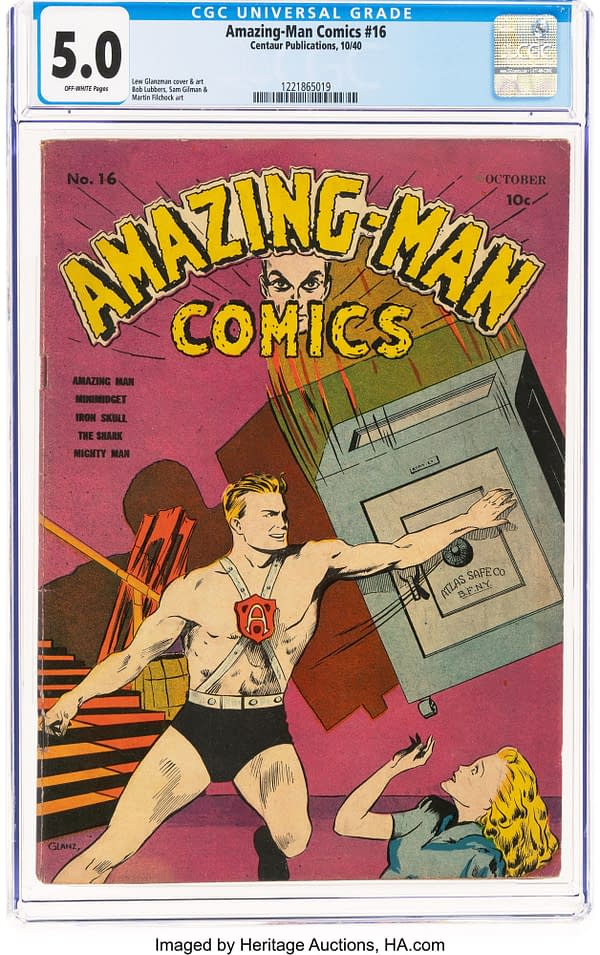
Agents of an unknown government have found a way to make a shipwreck pay twice in Amazing-Man Comics #16. Sinking a liner will bring in $50 million in insurance, while the deaths of its American sailors are supposed to pull the United States into the war on the conspirators' side. The Mighty Man adventure credited to Martin Filchock uses the size-changing character to good effect, as both a tiny spy and a massive figure capable of carrying huge ships. The story also references war-era policies, including the President's Neutrality Act by name and the 1939 Declaration of Panama by implication. Published by Centaur with an October 1940 cover date and a release date of August 2, the issue also includes an Amazing Man cover by Lew Glanzman and lead feature penciled by Allen L. Kirby and inked by Sam Decker.
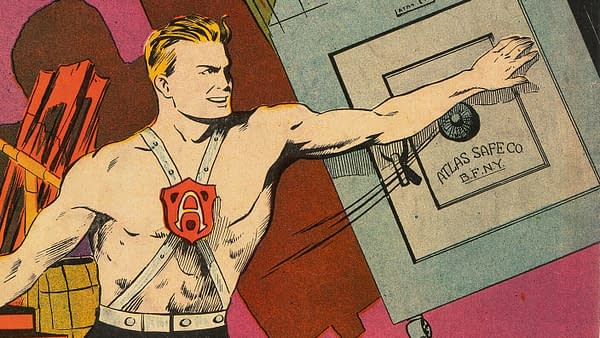
Mighty Man and the Plot to Bring America into War
The scheme begins at a Sixth Avenue employment office, where unemployed American men are offered $200 a week to work aboard a foreign liner. They're told to report to the docks at two in the morning. After getting underway the next day, a submarine appears 100 miles from New York, and the confrontation seems to justify Mighty Man's mention of the President's Neutrality Act. But a wounded conspirator explains the financial and political scheme. His government needs money, the liner is insured for $ 50 million, and sinking it within 300 miles of the coast with Americans aboard is intended to bring America into the war.
A threatened liner disaster had already become a matter for the White House in 1939. In his October 5 statement about the S.S. Iroquois, Franklin D. Roosevelt described German naval commander Erich Raeder's warning that the vessel might be sunk near the American east coast. The warning invoked the Athenia, whose sinking had become the subject of German allegations of British responsibility. The Iroquois was an American-chartered ship bringing Americans home from Ireland, and U.S. authorities arranged protection and a search for explosives. A liner carrying Americans, a possible disaster near the coast, and the prospect of an international incident were all part of that public warning.
Filchock's story remixes that combination of elements. The Iroquois was coming home with Americans aboard, while the liner in this Mighty Man story leaves New York with an American crew recruited for the trap. The conspirators' plan to sink the liner within a 300-mile zone also fits in here. The 1939 Declaration of Panama was designed to keep belligerent acts out of waters adjacent to the Americas. The State Department's explanatory map note describes a boundary constructed on a 300-nautical-mile basis. The November 1939 Neutrality Act separately restricted American ships from carrying "passengers or goods to any of the belligerent states." The comic story here seems to conflate these two policies.
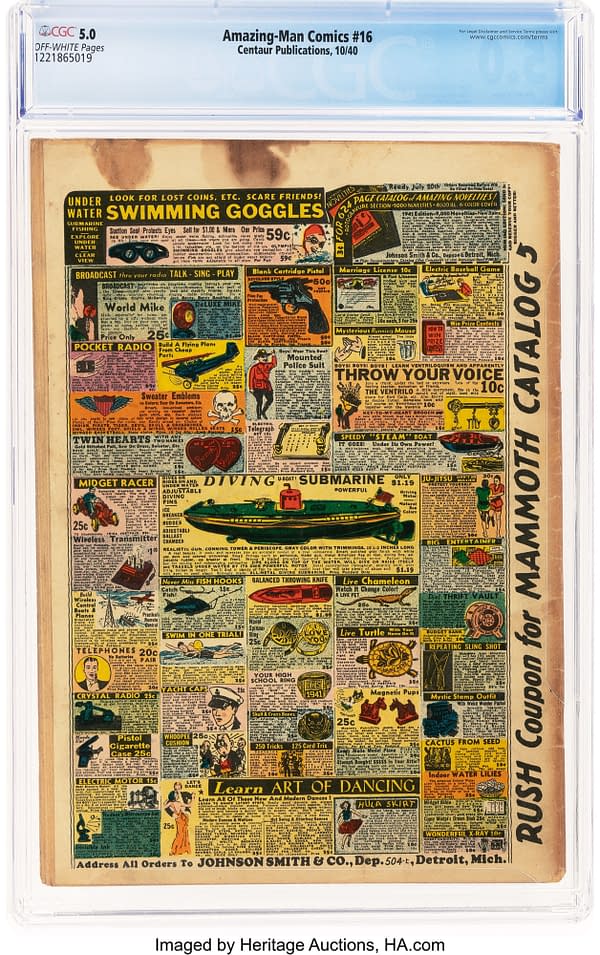
The CGC census currently has 20 Universal entries for this issue, with four at 5.0 and eight higher. A typically rare Centaur with a whole lot of fascinating WWII-era history packed into it, there's an Amazing-Man Comics #16 (Centaur, 1940) CGC Universal VG/FN 5.0 with off-white pages up for auction at the November 5, 2026 Golden Age Century Comics Showcase Auction VI #40378.

Affiliates of Bleeding Cool buy from and/or consign to Heritage Auctions.
Enjoyed this? Please share on social media!



Stay up-to-date and support the site by following Bleeding Cool on Google News today!


