
 About
About 

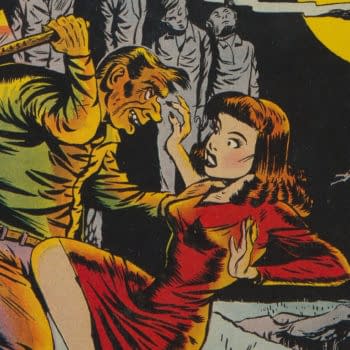
How Crime Does Not Pay remixed an established concept for comic books to achieve success in the Golden Age.
Posted in: Comics, Golden Age Good Girl Collection, Vintage Paper | Tagged: Crime Does Not Pay, lev gleason
How the Title Crime Does Not Pay Broke Containment in the Golden Age
How Crime Does Not Pay remixed an established concept for comic books to achieve success in the Golden Age.
Article Summary
- Crime Does Not Pay transformed the true crime genre in comics, drawing inspiration from print and film sources.
- J. Edgar Hoover’s FBI and Macfadden’s "true" magazines influenced the comic’s origins.
- Charles Biro and Bob Wood channeled cinematic and pulp traditions into Crime Does Not Pay’s controversial stories.
- The series’ massive success shaped the rise of crime comics and sparked divergence among major Golden Age publishers.
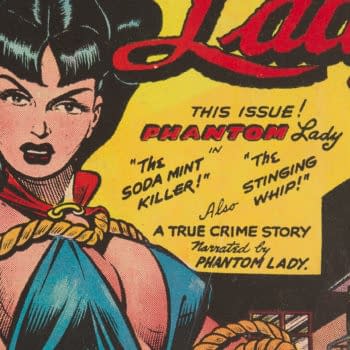
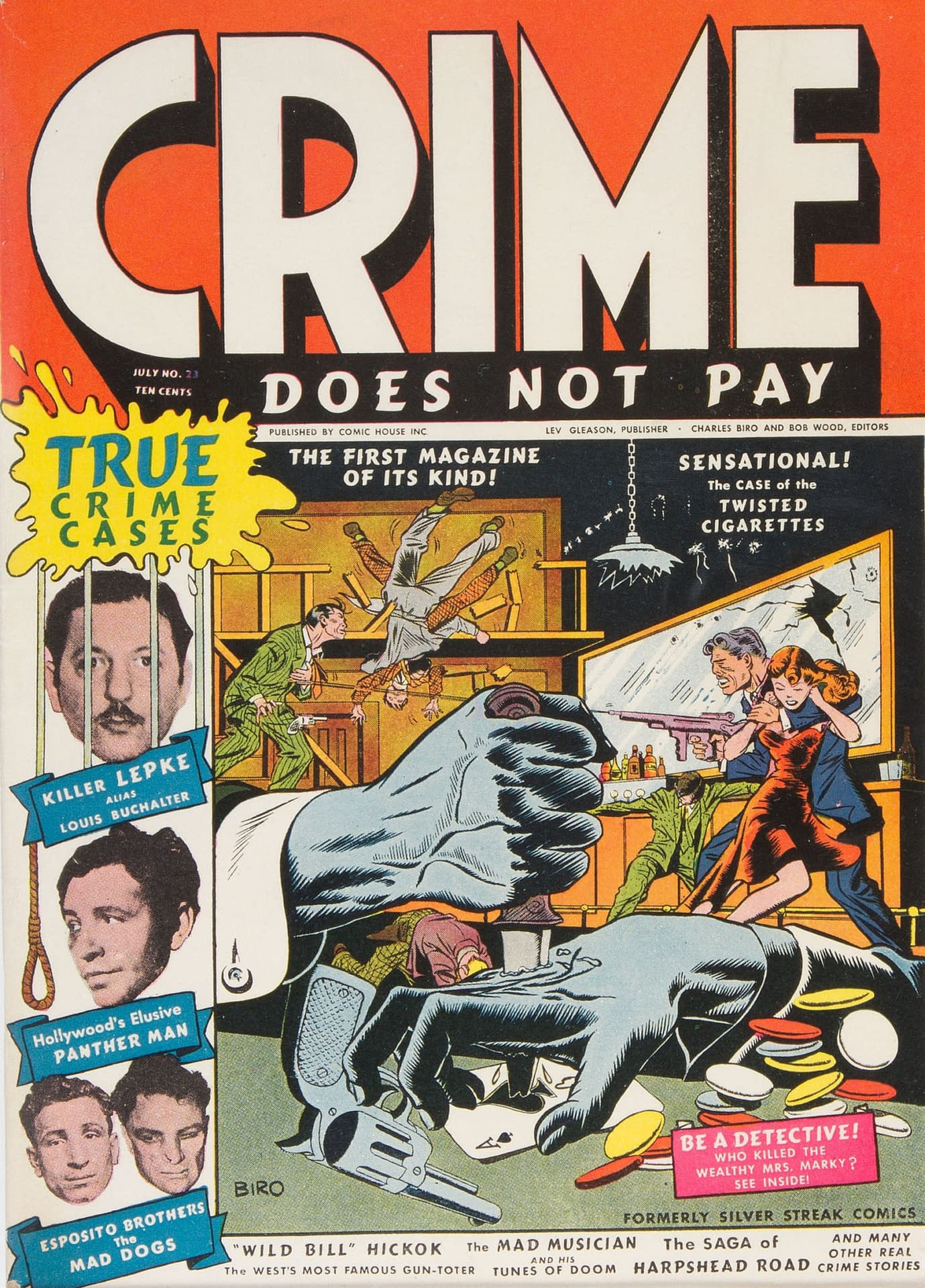
If Phantom Lady #17 is one of the most infamous single issues in vintage comics history, as we discussed last week, then Crime Does Not Pay is without doubt the most notorious comic book series in all of that history. It achieved incredible success while eventually inspiring the creation of the entire crime comics genre. But for such an infamous series, Crime Does Not Pay itself has curious predecessors and inspirations. The series did not contain the first true crime stories in Golden Age comics. That would be Famous Funnies #27, which hit newsstands in September 1936, running color collections of J. Edgar Hoover's War on Crime, a daily comic strip written by Rex Collier with art by Kemp Sterrett that began earlier that year, produced with the FBI's cooperation. What's more, the comic book title Crime Does Not Pay was generally inspired by (or perhaps better described as a subversion of) the MGM film series of the same name, which ran 1935-1947. MGM's Crime Does Not Pay was also the product of a collaboration with the FBI under Hoover's approval and control, and it was certainly a highly visible usage of the title phrase and general concept when the comic book launched in 1942.
In that context, the comic book Crime Does Not Pay might be thought of as akin to an idea born in a government lab that broke containment. While Hoover obviously didn't invent the idea of true crime content, he might be said to have helped provide a blueprint for implementing it in comics. Publisher Lev Gleason, and editors Charles Biro and Bob Wood appropriated the same commonly-used and now-famous phrasing "Crime Does Not Pay" and shifted the focus of the War on Crime blueprint from the police (or G-Men) back to the criminals to controversial effect. Movies and pulps had both attempted this in prior eras, and then faced censorship efforts. Movies famously had their "code moment" with the Hays Code in 1930-1934. Pulps had been through several waves of censorship by 1940. In a sense, the rise of comics opened a new frontier, one that initially sought to turn any attempt at media censorship against its own rules. At least for awhile.
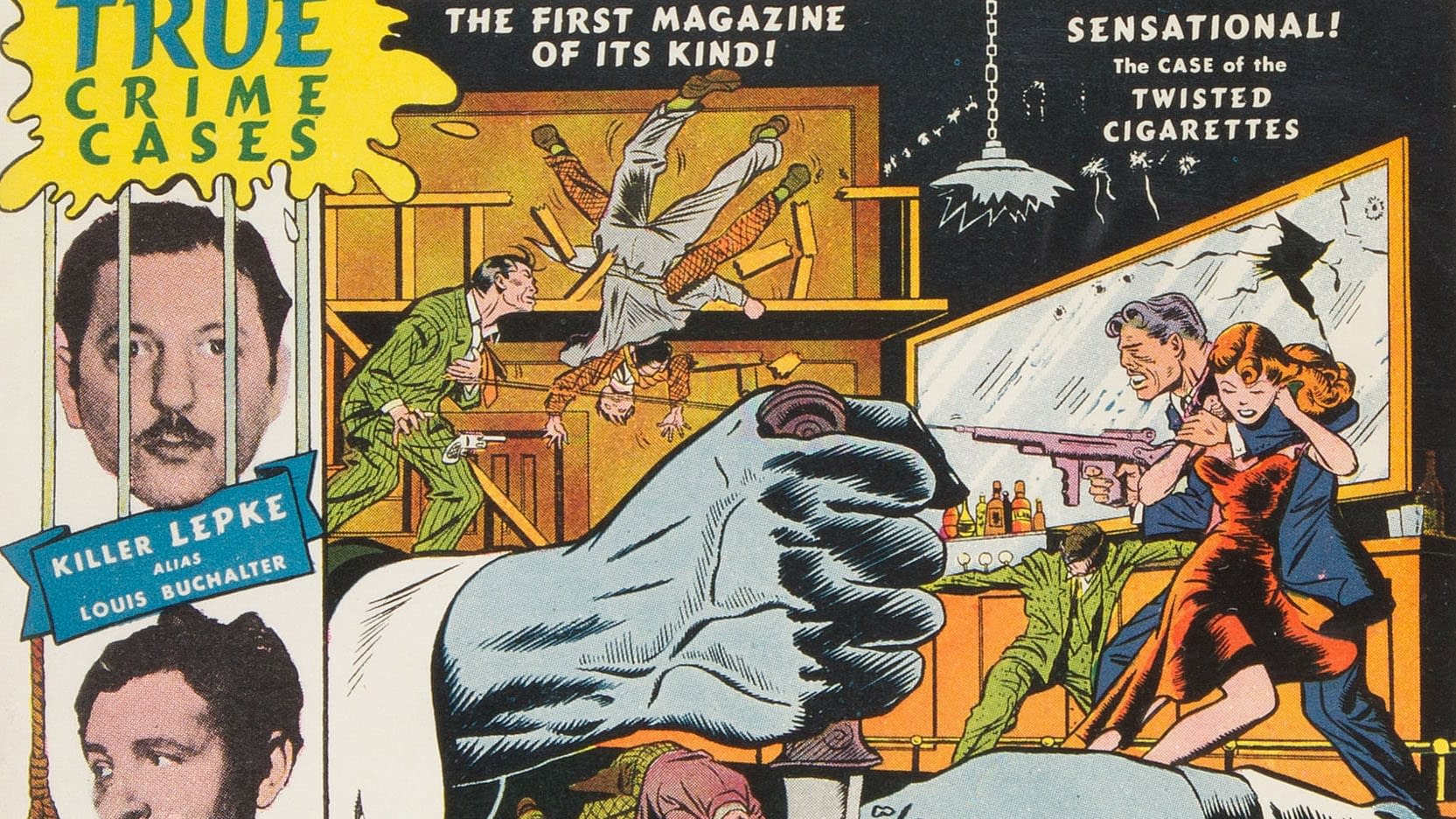
When Pixelmon Media recently asked us to talk about some of the comic books involved in their Golden Age Good Girl Comic Book Facsimile Collection Kickstarter, we noted that Phantom Lady #17 was an obvious place to start. Crime Does Not Pay #22, the issue that launches the series (we'll get into that shortly), is an even more compelling hook into comic book history, because it's a legendary comic book that has an awful lot of history behind it that isn't very well known. Some of the deepest roots of this history come from the mid-1930s film industry, even beyond MGM. Hoover's appreciation for the true crime genre was likely shaped in part by his subscription to the OG of that genre, the mind-bogglingly underappreciated True Detective magazine from Bernarr Macfadden. The crime comics boom that eventually developed also led to some diverging paths among publishers like Gleason, Archer St. John, Avon's Joseph Myers, and Alex Hillman among others. Even the best-known, most infamous, and certainly most tragic element of this history, Crime Does Not Pay editor Bob Wood's 1958 conviction for manslaughter in the first degree, has a bizarre and little-known footnote. The NY Daily News story about Wood's terrible crime is the foundational document from which this particular element of the history is known, and it was written by a comic book writer who almost certainly knew Wood professionally and once wrote an Angel story for Submariner Comics that referenced him.
The Origins of "True"
There are many places one could plausibly start a discussion about the history of true crime material on the newsstands. The Police Gazette, which was founded in 1845 and infuriated would-be censors throughout the second half of the 19th century, would be one plausible place to start. Hardold Furniss' Famous Crimes Past and Present, just after the turn of the 19th century and published in London, might be more directly on point. But for our purposes here, it most obviously starts with Macfadden. Considered the first confession magazine, Bernarr Macfadden's True Story Magazine was a massive success for its publisher right from its 1919 beginnings, spawning numerous "true" spin-offs at Macfadden and many imitators among other publishers. It also had a historically important impact on the contents of American newsstands in the decades that followed. Macfadden's follow-ups to this concept were sometimes iconic and successful titles in their own right, such as True Romance and True Detective, which began as True Detective Mysteries in 1924.
According to Mary Williamson Macfadden's account, the True Story concept and even the idea that it could lead to an entire line of magazines like True Detective had occurred to her while she was reading letters sent to Bernarr Macfadden's flagship magazine, Physical Culture. As the name implies, Bernarr was positioning the magazine to be as much about lifestyle as it was about physical fitness in particular, and readers apparently wrote in about the successes, tragedies, and dramas of their lives. Mary suggested that this could be the basis for a magazine — or several of them. "These are true stories," she recalled having noted to Bernarr in a February 1918 conversation. "They come from the following you have attracted–from readers you have created. Let's get out a magazine to be called True Story, written by its own readers in the first person. This has never been done before. I believe it will have a wide readership. It might lead to all sorts of other publications in the same vein."
As Mary describes it, the Macfadden empire had become financially strapped, and Bernarr was looking for a big idea to turn things around. He was not initially convinced by the concept, and decided to talk it over with his associates at the office the next day. This may be where the differing account of Macfadden editorial director Fulton Oursler comes in. By Oursler's account, True Story Magazine came about as the result of a conversation between Macfadden and writer/editor John R. Coryell. Coryell was an extremely successful writer, best remembered today as the creator and original writer of the detective character Nick Carter for Street & Smith. As the creator of the most popular and successful detective character on the American newsstands of its era, Coryell's opinion carried weight. Macfadden and Coryell discussed the idea that real life includes coincidences and inexplicable oddities that are often not accepted in fiction because readers would be frustrated by stories that left such things unexplained. That idea annoyed Macfadden, who reportedly noted, "I believe that people find such extraordinary coincidences in their own lives that they would recognize and confirm the naturalness of a coincidence in a true story." Coryell is said to have responded with the old adage, "Truth is stranger than fiction," and in 1919, the Macfadden magazine True Story, subtitled Truth is Stranger Than Fiction, made its debut.
While the "true" magazine genre was understood to be a marketing term rather than a statement of fact, exactly how much truth there was in the early years of True Story Magazine and others like True Detective is a matter of some debate. Initially, the material in True Story Magazine was said to be reader submissions and anecdotes rewritten by Macfadden staff, but the publisher hired a fiction editor in 1922. It soon began soliciting for story submissions in publishing industry trade magazines using "inspired by" phrasing such as "relating a real life plot as it has been lived by real characters." True Detective Mysteries began to shift away from such fiction throughout the 1930s and was renamed simply True Detective in 1941 to emphasize that point.
By the 1930s, Macfadden seems to have taken "true" in True Detective very seriously. According to the account of one contributor: "I am frequently asked if the photographs used in these stories are genuine and if the incidents related are authentic. If you are writing for True Detective Mysteries or the Master Detective, you will be required to furnish an affidavit, acknowledged before a Notary Public, in which you warrant that the pictures are photographs of the characters indicated in the story; that it is a true story of fact and that the real names and locations described have not been changed. You will also be required to send with your manuscript the sources from which you obtained your facts. Stories rewritten solely from newspaper accounts of the crime are not accepted. Blank forms for both of these requirements are supplied by the editor."
Another and more controversial title that dipped into true crime at Macfadden was Midnight (later retitled Midnight Mysteries and Midnight Mystery Stories) in 1922. Midnight is described in its introductory description for the publishing trade magazines as containing "stories about interesting places and personalities' fiction with and without thrills and enough mystery to satisfy the longest thirst" of the type that the hour of midnight might generally inspire, such as "a midnight holdup, a strange phone call at that mysterious hour, an encounter with a ghost, etc." Mary Macfadden noted that, " The publication was called Midnight, a title which our new editor said he had evolved from the theory that people who went to bed at a normal hour would want to know about the terrible things that happened in New York while they were asleep…. Its policy, as one of its subordinate editors put it, seemed to create the impression that 'everything in New York was going to hell in a handbasket.'"
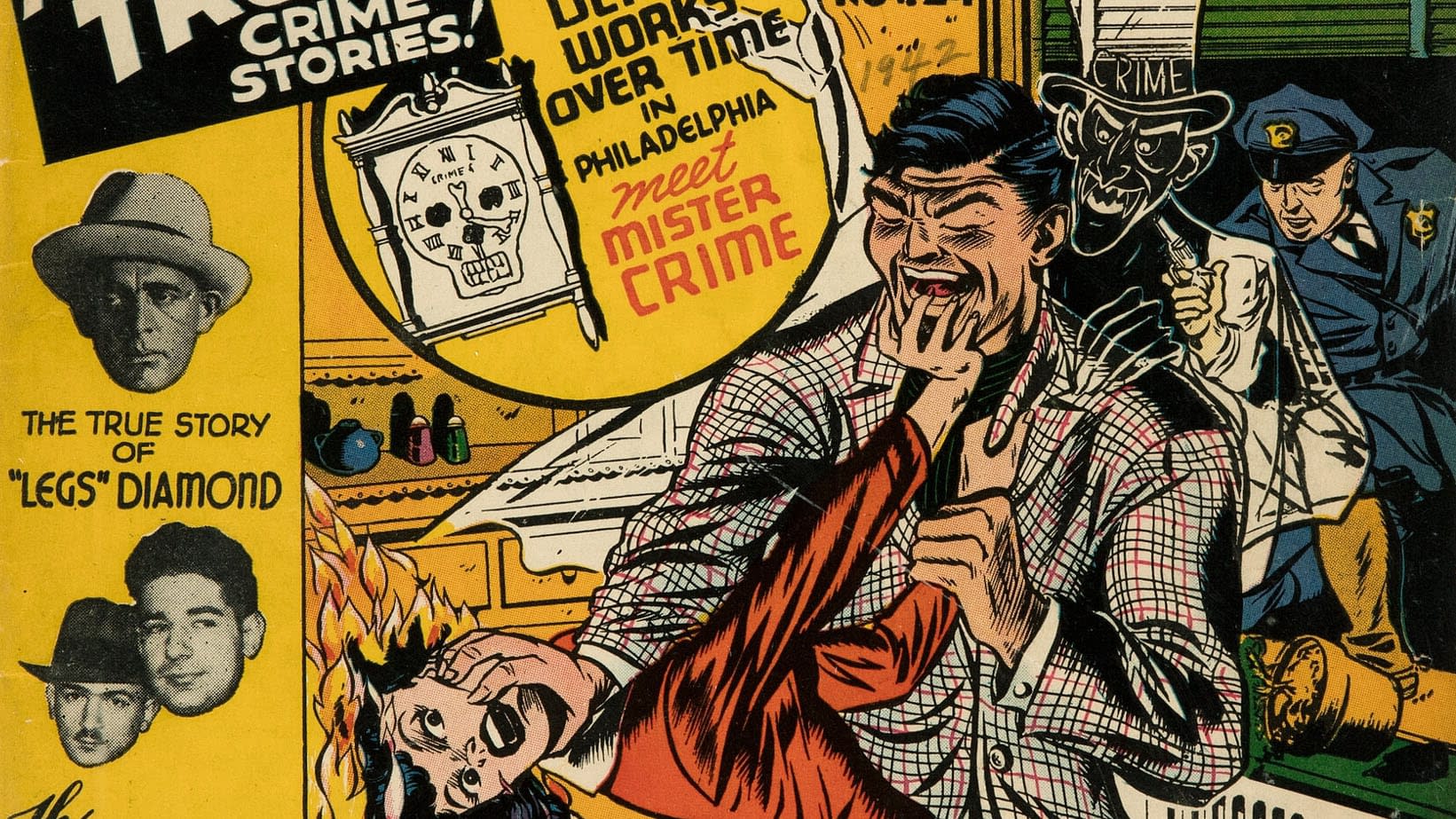
MGM, Crime Does Not Pay, and the Film Industry Under Fire
With true crime story content on the rise in print media, the film series Crime Does Not Pay began development at MGM in 1933. But during this period, the film industry was under fire for its content on various fronts, and the Hays Code was implemented in 1930 and would be strictly enforced beginning in 1934. In this atmosphere, director William T. Orr of MGM wrote to Hoover to outline a way that a film series about true crime could be developed in a more palatable way: "We would like to get the approval and co-operation of your Department for these pictures so that they could be based on real life as represented in some of the cases in your files. We would expect to disguise names and locations as you would direct, and would try to make such pictures always drive home the point that crime does not pay." By spring 1933, the plan for this series was in motion, with writer George F. Zimmer discussing specifics with Hoover, giving the FBI complete control over the series:
In order that these productions shall be precisely what the Bureau desires the following plan will be adhered to;
-
With your help we will select the most desirable cases for the purpose.
-
A writer and myself will then write these stories in scenario form (in Washington) and I will present each to you for changes or suggestion and make each conform to what you desire (the same method I used in the Radio presentation of cases) This gives you complete control of the material and story.
-
A presentation title or forward of each picture will state in a very complimentry manner to the Bureau that through its courtesy these cases have been provided from its files etc. (similar to the presentation we have been using with the Radio and in the Newspapers) The exact wording of same you can determine while we write the scenarios.
Meanwhile, during exactly this period, Bob Wood and Charles Biro were both working in the film industry. Biro worked as an animator and sketch artist for Van Beuren Productions, where Paul Terry of Terrytoons fame was a principal figure. He may have also worked for Fleisher Studios during this time, where Bob Wood had done some work at around this time. According to the GCD, one of his assignments at Fleischer Studios was for Betty Boop during the period 1934- 1937. The character was transformed significantly due to Hays Code enforcement during this period. It is not unlikely that both Biro and Wood observed the Has Code's effects on the film industry firsthand during this time.
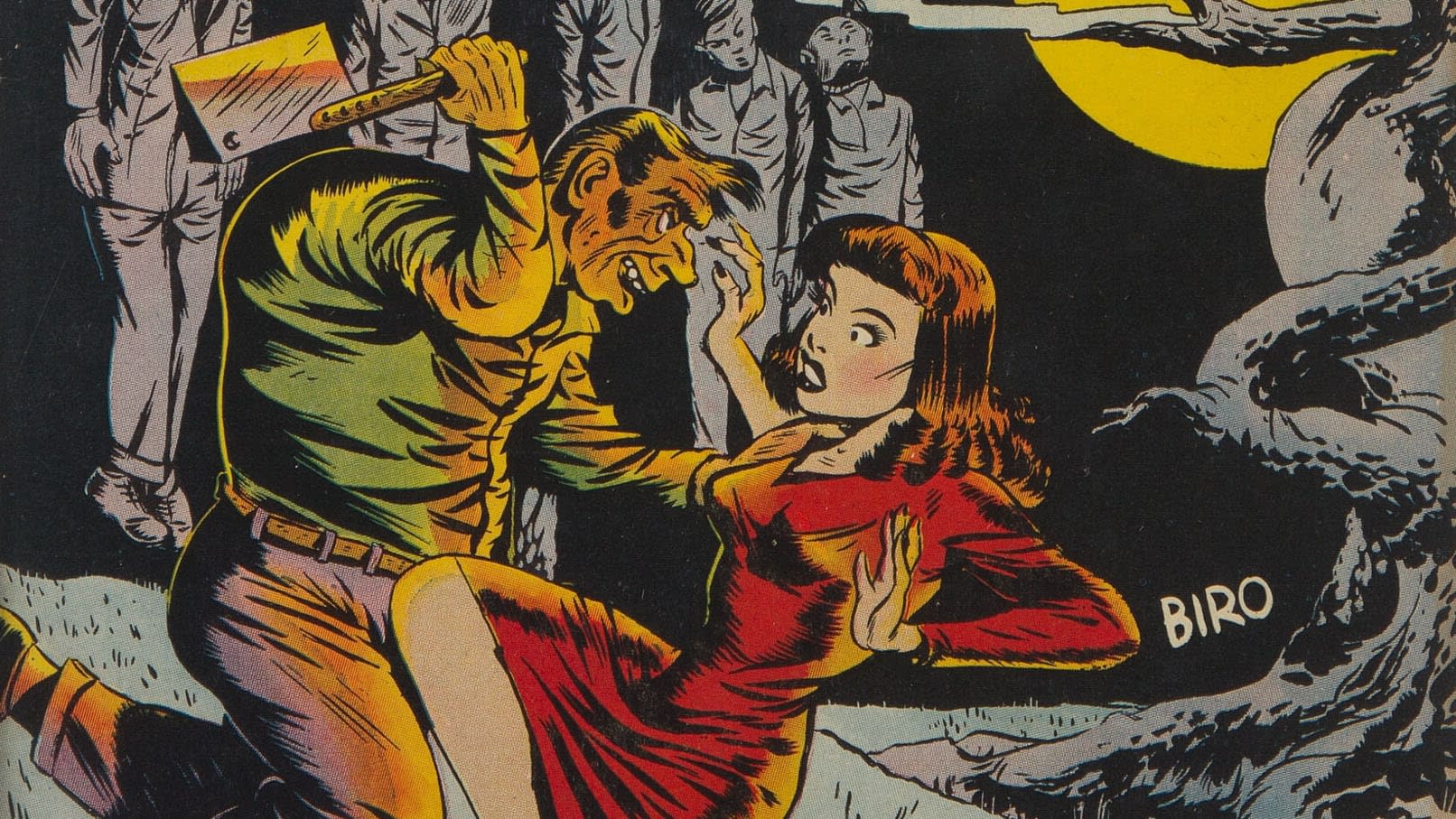
Biro and Wood Hit the Target
According to a widely-repeated comics industry legend, as related in Blab! #6 (among other places) Charles Biro was the originator and driving force behind the Crime Does Not Pay concept, laying out the idea for Bob Wood in a Broadway bar. If that's true, the title may have been a long time in the making. Wood and Biro had known each other since at least 1937, when both worked for the Harry Chesler studio. Wood first prominently used the phrase "Crime Does Not Pay" in print in the debut of the character the Target in Target Comics #10, as the hero's warning to criminals that issue. That issue hit newsstands in September 1940 and would have been in production perhaps three or four months earlier. Wood would then seemingly foreshadow both his and Biro's future a few issues later in early 1941's Target Comics v2 #4, which centers around a scheme whereby the stories in a syndicated newspaper comic strip would provide directions for specific crimes to a criminal gang. Biro's name was used in the story for a character who was in on the scheme. Of course, Biro and Wood's Crime Does Not Pay would be accused of inspiring and providing methods for crimes countless times after the title's 1942 debut. The story also contains a reference to inker and artist George Roussos who was also working for Lev Gleason by this time.
The Lev Gleason biography American Daredevil by Brett Dakin refines the foundational comics industry legend regarding this matter with additional info. According to this account, Charles Biro had been inspired after a chance encounter with a serious criminal in Armand's Hi-De-Ho Club, a bar near Times Square in New York City: "Why not produce a comic book about these crimes? Each issue would tell the full story of a real-life criminal, the details of the horrible deeds he committed, and, finally, his comeuppance at the hands of the law. To a story man like Biro, the concept was brilliant—the newspaper provided the material. Together with Wood, Biro worked hard to refine the idea. They chose a title, 'Crime Does Not Pay,' taken from a series of true-crime short films produced by MGM."
Biro and Wood sold Lev Gleason on the idea, and an apparent disaster looming in Silver Streak Comics provided the timing and numbering opportunity. Publisher Lev Gleason had a lot riding on the appearance of The Saint in the company's early-days flagship title Silver Streak Comics. In an editorial in issue #20 of that series, he noted, "I have spared no expense to give you the very best. We lead off in this issue with The Saint by Leslie Charteris. As far as we know this is the most expensive feature ever to appear in a comic magazine. Written by Leslie Charteris himself, The Saint comes to you right out of the movies — to perform here exclusively his terrific adventures and clever detective work that have made him world famous." Gleason's expensive gamble didn't pay off. The Saint had started in Silver Streak Comics #18, and three issues later (and one issue after Gleason had boasted about how much he was paying Charteris to get The Saint in comics) the title was dead — to be replaced by two months later with Crime Does Not Pay for issue #22.
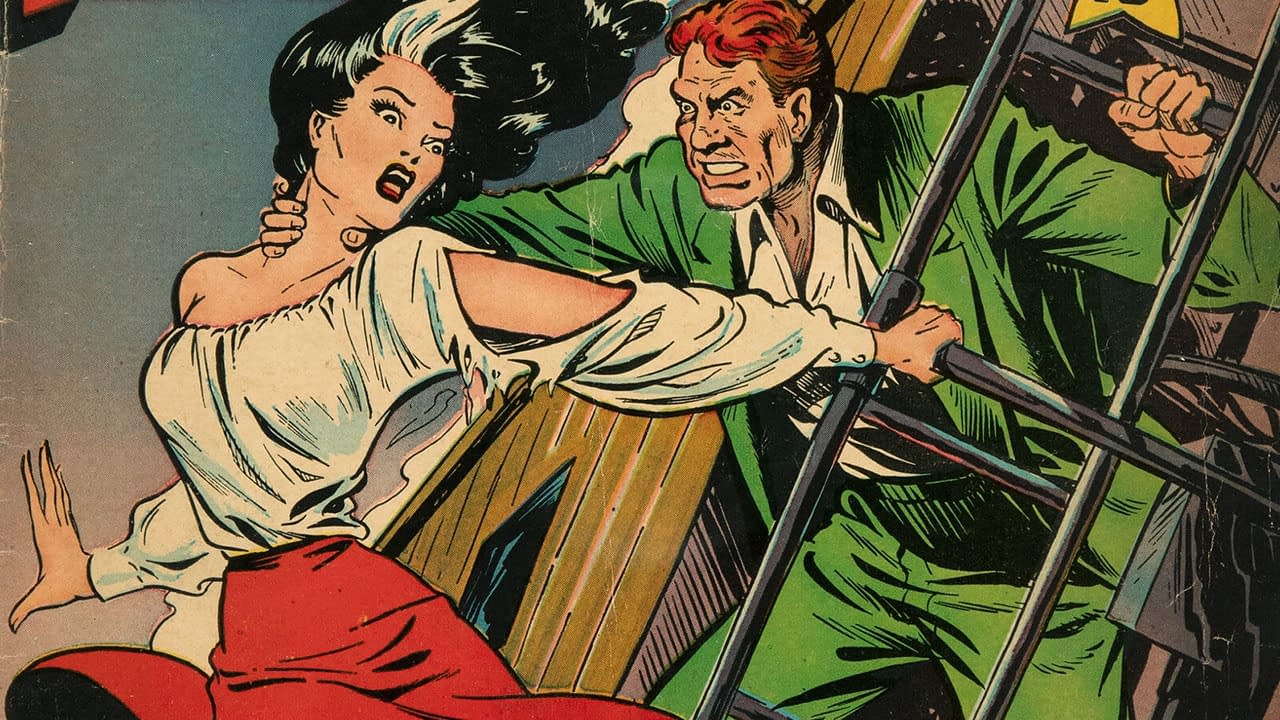
In the Wake of Crime Does Not Pay
The rest of the industry naturally took notice of the quick and unique success of Crime Does Not Pay, including Hillman Publications. Charles Biro and Bob Wood's exceedingly brief late 1942 stint at Hillman Periodicals seems to be a a high profile misfire from this period. The pair had been editors and contributors at publisher Lev Gleason for nearly a year by that time, and had three issues of Crime Does Not Pay under their belts. Gleason is widely said to have paid and treated them (and other creators for that matter) very well by the standards of the era. Alex Hillman, as the publisher of true crime magazines such as Crime Confessions and Real Detective, certainly seems to have intended the title Clue Comics to be a crime- or detective-oriented comic book as well. And had hired the team behind one of comics' hottest new releases in Crime Does Not Pay to help them create that new crime comic, just four months after CDNP launched.
But if Hillman wanted a crime comic from the launch of Clue Comics, which seems likely, he didn't get it. Despite claims on the early covers that it was a crime comic book, it was pretty obviously a superhero/adventure series. Biro and Bob Wood's contribution was an unusual feature called The Boy King and His Giant, about the young king of the central European kingdom of Swisslakia and the giant, Golem-like statue that he controlled. Were Biro and Bob Wood unable to deliver something similar to CDNP due to obligations to Lev Gleason? Impossible to say absent some evidence, but their freelance moonlighting stint for Hillman ended after four months.
Archer St. John was another publisher who took an unlikely path through the crime comics boom. Titles like Crime Does Not Pay , Gangsters Can't Win, True Crime, and most others that positioned themselves as true crime made an effort to chronicle the exploits of real-life criminals with at least some regularity. St. John had first-hand experience with some of history's most notorious gangsters, so one might have expected him to go all-in on the genre. But with rare exceptions (including an occasional one-page bio of historical criminals), Authentic Police Cases did not feature the kind of high-profile true crime stories that many of its competitors thrived on. Ultimately, it's hard not to wonder if publisher Archer St. John's life experience influenced this editorial decision. As a newspaper editor and publisher in the 1920's, Archer and his brother Robert were terrorized by the notorious Al Capone himself for their newspaper coverage of the legendary mobster in that era. Even without regular appearances by the type of headline-making gangsters and killers often featured in the era's crime comics, Authentic Police Cases had a relatively successful run for a St. John comic book, starting in 1948 and ending with the arrival of the Comics Code. That's largely because of the talents of Matt Baker, whose first work on this title is the cover of Authentic Police Cases #6, one of the stand-out issues in the Golden Age Good Girl Comic Book Facsimile Collection Kickstarter.
William K. Friedman's Fight Against Crime is another completely fascinating series represented in this Kickstarter. We've come back to Friedman's 1954 moves often in our discussions about the final months of the Pre-Code era. This was the peak moral panic year for comic books, and most publishers spent the months between the April 1954 Senate Hearings on comic books and the announcement of the development of the Comics Code that September either figuring out how they were going to survive or if they were going to give up entirely. Publishers like Marvel's Martin Goodman and even Lev Gleason were toning down their most extreme content during 1954, well before the announcement of the Comics Code. But not William K. Friedman who owned and/or operated publishers Premier, Story Comics, and Master Publications. It would appear that the Senate Subcommittee had made Friedman angry, because in the months after the hearings but before the Code, he proceeded to publish exactly what the would-be censors hated most. His horror comics became more extreme. His romance comics became more extreme. And his crime comics also became more extreme. Fight Against Crime #20 might just be the most sought-after crime cover of the later Pre-Code era.
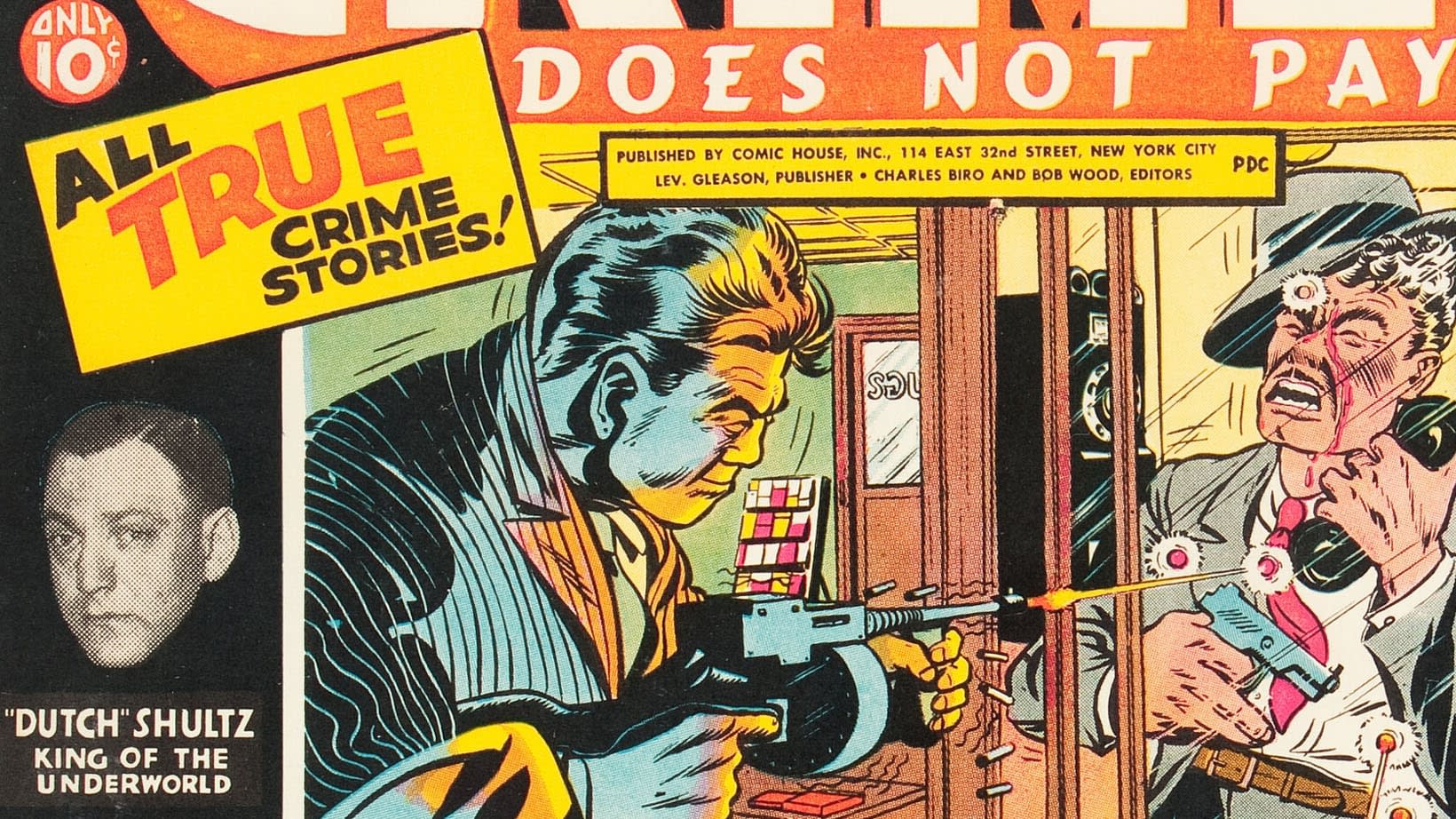
Bob Wood: Gramercy Park Gets The Horrors
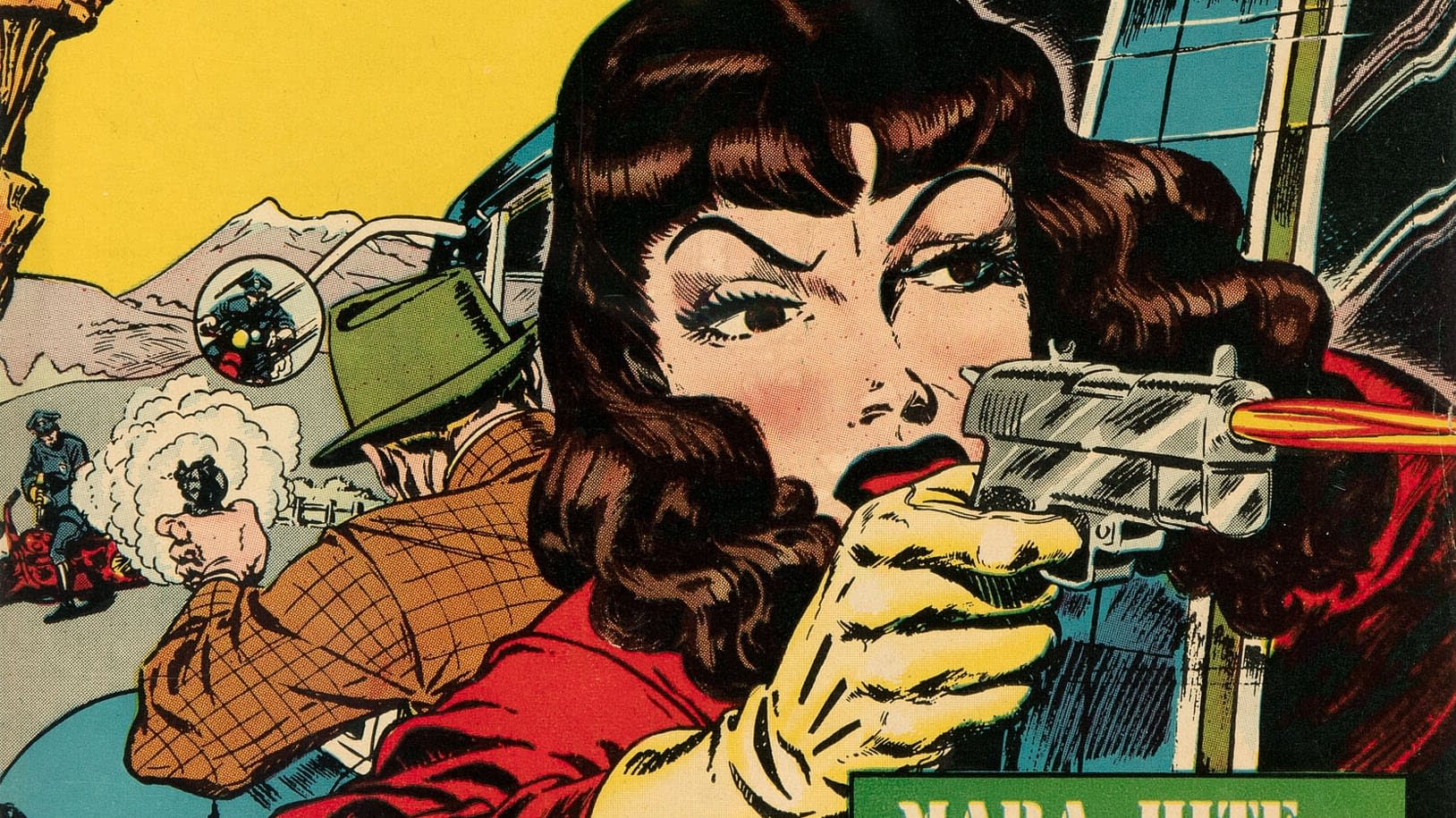
The most terrible and tragic moment connected to this history came in 1958, about three years after Comics Code brought a conclusion to the crime comics era. The most visible historical document of Bob Wood's own crime that year was chronicled in the New York Daily News by a writer named Kermit Jaediker. In addition to being a journalist, Jaediker was a comic book writer and letterer associated with the Funnies, Inc. studio during the 1940s. He also dabbled in pulp and paperback fiction, and wrote a pair of noteworthy murder thrillers for one of Marvel/Timely Comics founder Martin Goodman's paperback imprints of the era, Lion Books. Jaediker wrote about crime, often. He did so in newspapers, pulps, paperbacks, and comics over a professional writing career that spanned decades.
Jaediker's comic book credits include some work for Lev Gleason, where Bob Wood served as editor and writer. He likely knew Wood personally, certainly knew him by reputation, and did not mention that in his article for the Sunday edition of the New York Daily News. He did seem to reference Bob Wood in his Angel story in Submariner Comics #8 (Winter 1942), however. The story is about a murder mystery writer who has just received a rejection letter from "James Nodd" of "Detective Stories Magazines". In real life, Bob Wood was the editor/writer of Crime Does Not Pay. Bob Wood… James Nodd… is this actually a story about not being able to crack into Crime Does Not Pay? The story also names a few thinly disguised versions of people who worked at the Funnies, Inc. studio, where Jaediker himself worked. The rejection letter tells the writer that he ought to stick to subjects he's familiar with in real life. Jaediker, who wrote extensively about crime in both fiction and reality, has no known credits for Crime Does Not Pay.
In addition to the infamous Gramercy Park Gets the Horrors story, Jaedicker would go on to become known as the writer of a newspaper story that triggered a purported Zodiac Killer letter. "YOU WERE WRONG I AM NOT DEAD", begins a chilling letter mailed to the Times-Union newspaper of Albany, NY in August 1973 in response to a Jaediker piece. "Or in the hospital I am alive and well and Im going to start killing again. Below is the name and location of my next victim But you had Better hurry because I'm going to kill her August 10th at 5:00 PM when the shift change. Albany is a nice town." The letter ends with what had become the familiar symbolic signature of the Zodiac Killer, followed by a series of hand-drawn figures meant to be cryptographic symbols which the police or FBI were supposed to solve. This particular 1973 letter has not been confirmed to be from the Zodiac Killer, and its authenticity is debated to this day.
Joseph Myers: Avon Calling
There are a number of footnotes that could be made here, but one in particular is about Joseph Myers, whose publishing company, Avon, has a few comics represented in the Golden Age Good Girl Comic Book Facsimile Collection, including Eerie Comics #1, which is considered the first Pre-Code horror comic book. Whereas Lev Gleason's relationship with Leslie Charteris seems to have blown up almost immediately, The Saint was a cornerstone of Myers' paperback success. Myers had been in the business of publishing paperback editions of The Saint book series for years when he wrote Charteris about the idea of a comic book featuring the character in 1944. While Myers, mindful of wartime paper regulations, pitched the title as a potential quarterly in 1944, it appears that Charteris preferred to wait until it could be published monthly. But significant newsprint shortages continued after the war, perhaps accounting for the mid-1947 launch date of Avon's The Saint comic book a year and a half after wartime paper restrictions had ended. The title never did make it to the planned monthly release schedule.
That was just the beginning of what seems to have been a somewhat problematic production for the series, which might explain why the series cycled through several cover artists before settling on using previously-approved painted artwork from Avon's The Saint paperbacks. Avon's documented difficulty in getting approvals from Charteris may also give us a hint as to why Gleason couldn't make a go of The Saint in Silver Streak Comics, leading to the launch of Crime Does Not Pay. We'll have quite a bit more about Joseph Myers, Eerie Comics, and so very much more about the Pre-Code horror in the Golden Age Good Girl Comic Book Facsimile Collection next time.

Enjoyed this? Please share on social media!



Stay up-to-date and support the site by following Bleeding Cool on Google News today!