
 About
About 

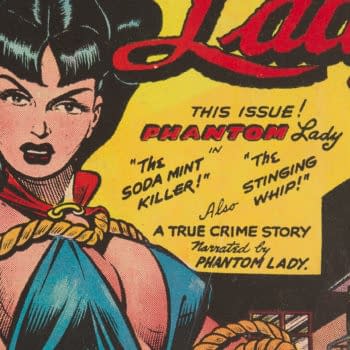
A deep dive into some of the issues involved in the Golden Age Good Girl Comic Book Facsimile Collection Kickstarter, starting with Phantom Lady #17.
Posted in: Comics, Golden Age Good Girl Collection, Vintage Paper | Tagged: Matt Baker, phantom lady, victor fox
The Notoriety of Matt Baker's Legendary Phantom Lady #17 from Fox
A deep dive into some of the issues involved in the Golden Age Good Girl Comic Book Facsimile Collection Kickstarter, starting with Phantom Lady #17.
Article Summary
- Phantom Lady #17 epitomizes the notoriety of Golden Age comics linked to Fredric Wertham's Seduction of the Innocent.
- Matt Baker's iconic Good Girl artistry and Ruth Roche's scripts redefined Phantom Lady during the late 1940s Fox era.
- Victor Fox's risky shift from humor to Good Girl art and vertical integration transformed Fox Feature Syndicate.
- Phantom Lady's history traces back to pre-war atomic themes and evolves through industry turbulence and censorship battles.
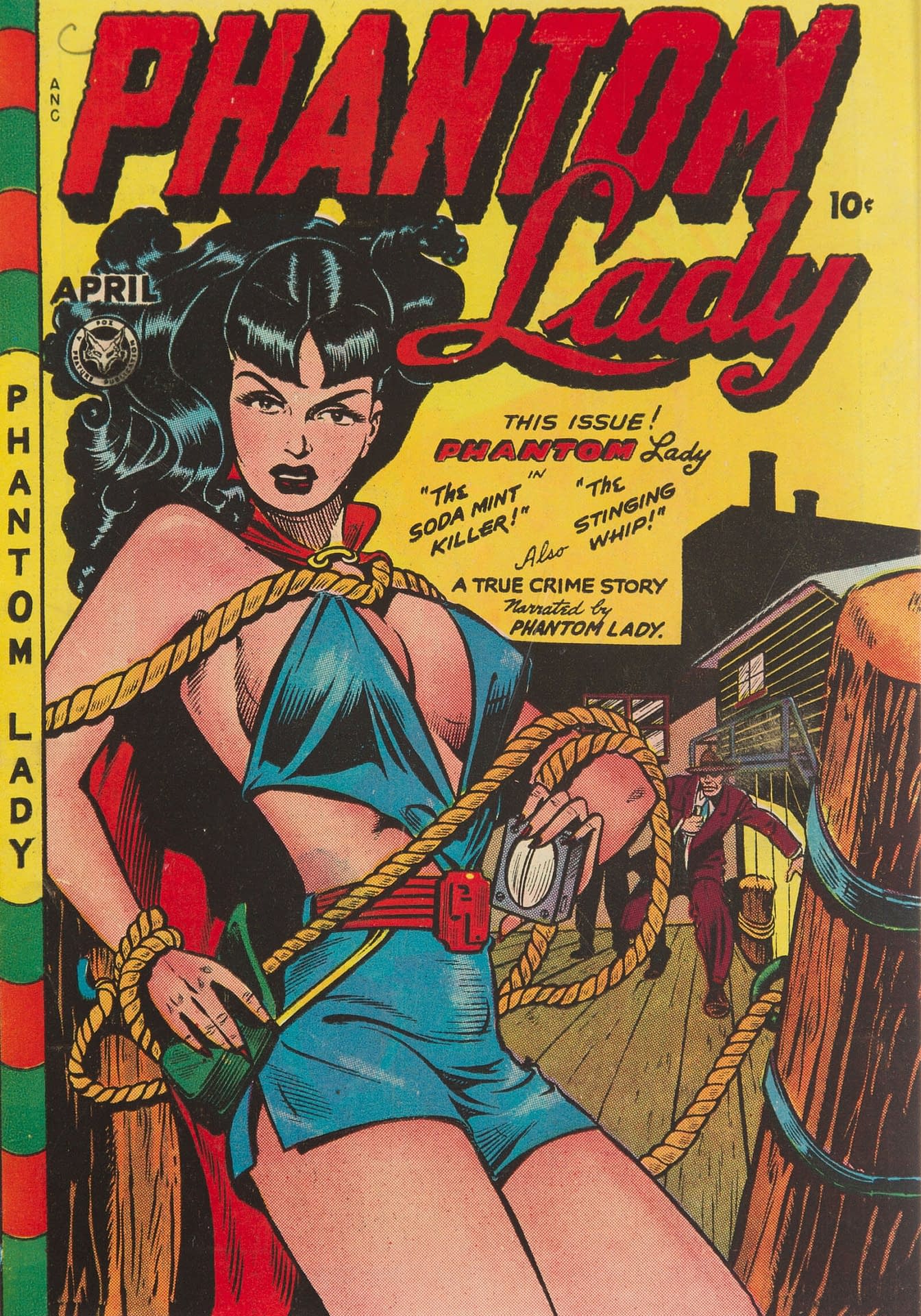
There's more than a little irony in the notion that Fredric Wertham's Seduction of the Innocent cemented the legendary status of a number of comic books, and arguably an entire era of them. Practically used as a guidebook to that era's most notorious comics by collectors in the decades since, no single book has benefited from Wertham's scorn more than Phantom Lady #17. When the Promise Collection CGC 9.6 copy sold for a record $456,000 in 2021, we noted that it was no coincidence that one of the most infamous comic books in vintage comics history was published at a moment of one of the industry's greatest peril. That moment culminated around six years later with Senate hearings, the formation of the Comics Magazine Association of America, and the institution of the Comics Code. There's been much written about that period of comic book history, but Phantom Lady #17, as infamous as it is, also symbolizes an earlier part of that history which is far less known.
Pixelmon Media recently asked us to talk about some of the comic books involved in their Golden Age Good Girl Comic Book Facsimile Collection Kickstarter. We soon found that it was both easy and difficult. Easy because their list contains a large number of our favorite comic books from the period, and difficult because it's no small task to narrow that list down to a few comics to talk about in depth. Taken as a whole, the issues on the list tell some fascinating stories, both in their pages and with the history behind them. But of all the issues to choose from here, Phantom Lady #17 is perhaps the easiest choice to make of all. It's the story of an industry in flux in the wake of World War II, of an artist rising to the peak of his abilities, and of a publisher taking one of the biggest swings of his scandalous career. Not only did Victor Fox practically bet his own company that his publishing strategy during the late 1940s Phantom Lady era would work, but he also acquired his own printing plant and paper mill to implement it. These various threads leading up to the time of Phantom Lady #17 tell quite a wild tale all their own, ranging from Columbia Pictures choosing to put The Batman movie serial on its schedule rather than moving forward with a previous commitment for a Blue Beetle serial at the cusp of Fox's bankruptcy, to his disasterous attempt at publishing a children's humor line which lead directly to the Fox Good Girl era.
The Debut of the Debutante: Phantom Lady and the Atomic Bomb
From our modern perspective, the early Quality Comics days of Phantom Lady are overshadowed by the Fox era, as defined by Matt Baker. And in her 1941 first appearance in Quality's Police Comics #1, the character was quickly overshadowed by the debut of Jack Cole's Plastic Man, which began in that same issue. But Phantom Lady's Quality Comics era is quite a bit more interesting than history remembers. Created at Eisner & Iger Studio by an unknown writer with art by Arthur Peddy, Phantom Lady was established there as "Sandra Knight, debutante daughter of Senator Henry Knight. No one suspects that frivolous Sandra is also the Phantom Lady, whose battles against spies and public enemies constantly made headlines."
The first adventure that followed that title page blurb established its intent very well. Sandra's father, Senator Henry Knight, brings her along on his investigation of what turns out to be a working atomic bomb, with a scientist who notes, "My uranium explosive has tremendous force. The test will prove that." This "uranium explosive" widely outperforms dynamite in the test, which naturally attracts the attention of spies to obtain its secrets. It's clear that the creators were inspired here by an August 1940 AP newswire blurb, which likewise states that a newly developed uranium explosive has dramatically outperformed TNT in testing, with the article stating, "Although the amount detonated was so small, the resultant air blast shook a tower more than a mile away."
This rather startling moment from a 1941 comic book has passed largely unnoticed in the history of the medium, which is usually pretty good at noting such things. While warnings about the theoretical possibility of a uranium bomb began appearing in newspapers in 1939, Police Comics #1's 1941 debut was still over a year before the Manhattan Project officially began in secret. That said, it's possible the 1940 AP blurb that inspired Peddy and the writer was a bit of propaganda, which was not uncommon during the era. The scientists named in the article and their experiments seem to have gone otherwise unrecorded by history, although the mentioned Hercules Powder Company was a real chemical and munitions manufacturer.
The reason behind the name Phantom Lady is also introduced in this first adventure. Her Black Lantern (also variously called a "black light") is a handheld lantern or flashlight-like device that emits a beam of black light, rendering her opponents blind while it is cast upon them. Her car is shown with headlights that can produce the same black light. Like the uranium bomb element, the black light can also likely be sourced from another August 1940 newswire blurb about the development of a light that "sheds no light to the human eye, but infinite light for the aviation industry." This was a UV-A light that could be used to illuminate specially painted instruments in an airplane cockpit. As the inventor himself noted, "This device isn't new. Do you recall how they used to black out the theatre in the old vaudeville, leaving only a beautiful girl on the stage illuminated?" One can easily imagine how Peddy and the writer were inspired to Phantom Lady's version of a black light by that particular line. The beautiful Phantom Lady can see and act, while her opponents are left in the dark.
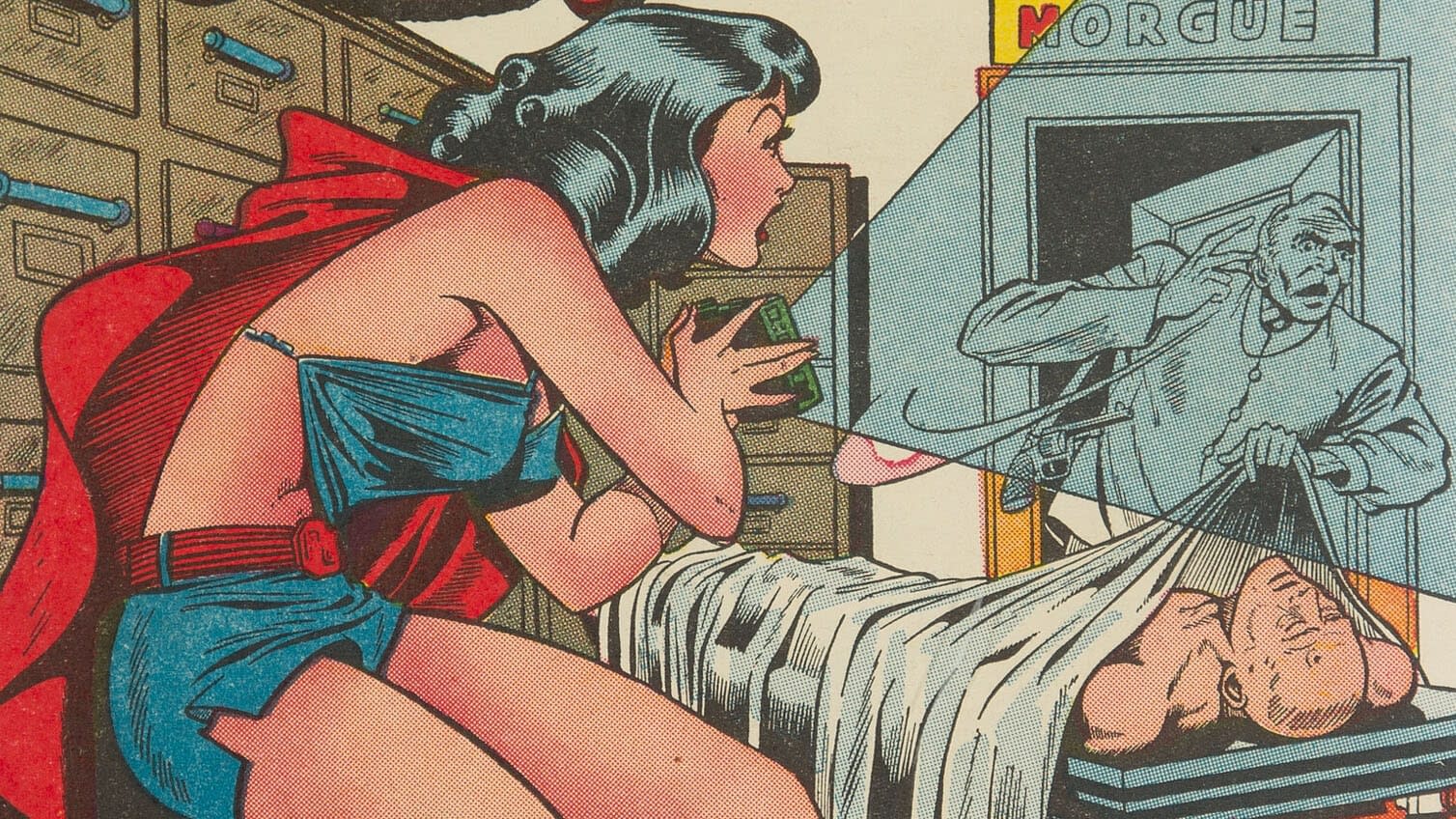
At Quality Comics, Phantom Lady appeared in Police Comics #1-23 and Feature Comics #69-71. Joe Kubert drew her adventures in Police Comics #14-16, when he was 16 years old. Frank Borth took over the Phantom Lady saga for Police Comics #17-21, introducing a sexier plunging neckline and backless costume top that would be refined again by Matt Baker with iconic results during the Fox era. The Golden Age Good Girl Comic Book Facsimile Collection has Police Comics #1-23 listed among its tiers as well, and this underappreciated run is well worth your time.
The Trials and Tribulations of Victor Fox
While Quality Comics founder Everett M. Arnold had deep experience in publishing-related fields by the time he got into the comic book publishing himself, Victor Fox took a very different path. Unlike most comic book publishers of his era, Fox had no prior publishing experience before entering the field in 1937 with World Astrology Magazine. By most accounts, Victor Fox was one of the most disliked publishers of the Golden Age, based on later accounts from people who worked for him. As a businessman, Fox was shrewd but seemed unable to rein in his appetite for risk. Having gotten himself into the landmark lawsuit Detective Comics, Inc. v. Bruns Publications, over what amounted to sneaking a peek at Action Comics sales figures during the rise of Superman and subsequently launching the purportedly similar superhero Wonder Man in Wonder Comics #1, Fox was completely undeterred by what most would have considered a company-threatening setback. With the Wonder Man decision still under appeal, Fox launched an entire line of comic books in 1939 alone, including Wonderworld Comics, Mystery Men Comics, and Fantastic Comics, and rather blatantly swiped the cover and concept of DC Comics' New York World's Fair 1940 with the launch of his title Big 3. Then, with the ink barely dry on the Wonder Man appeal in 1940 (the decision against Fox was affirmed), DC Comics sued Fox once again, this time over seemingly copying Batman and Robin. He lost that case in a 1942 court decision as well.
Lacking prior publishing experience, Victor Fox was clearly determined to emulate what Harry Donenfeld was doing at DC Comics at multiple levels. Fox leased an office at the Grand Central Palace that also housed DC Comics. He then launched his own magazine line, followed by the short-lived Wonder Comics, and then his other 1939-era titles. Like Donenfeld with his Independent New Co. distributor, Fox also started his own distributor in Colonial News Co. Seeing Superman's popularity boom and expand into newspaper strips and far beyond, Fox connected with experienced syndicated strip vet Robert Farrell, and looked to leverage Fox properties by hiring the Mitchell J. Hamilburg Agency to help get them into film, radio, merchandise, and syndicated newspaper strips.
In September 1941, Fox announced to newsdealers via Colonial News that he had struck a deal with Columbia Pictures for a Blue Beetle film serial. The man who made the deal, producer Larry Darmour, had also done the deals that brought the pulp character The Spider and radio and comic book hero Captain Midnight to film. This seemed to be the moment Fox had been working towards, and might have capped off an impressive run toward greater success as a publisher. But he had expanded quickly throughout 1940, had notably slowed down his new series launches in 1941, and by the end of that year, facing an increasingly crowded comic book market, the cracks were showing.
And then things got worse for Fox's prospects for a media empire. In late 1941, Larry Darmour underwent abdominal surgery, from which he never recovered. Fox Feature Syndicate and Colonial News Co. declared bankruptcy on March 6, 1942. Darmour died two weeks later. In April, Darmour's wife confirmed to Variety that his production studio would continue operating and that Blue Beetle was among the projects currently on the production schedule. But by the next month, it had dropped off the Darmour Studio schedule. By June, Columbia's Ralph Cohn had taken over the Darmour Studio, and it was announced that Darmour would be producing "The Bat Man" for Columbia. Then shortly after that announcement, Larry Darmour's former co-producer, Rudolph C. Flothow, had been put in charge of Darmour Studio to replace Cohn, and Darmour Studios' go-to director, James W. Horne, who had directed Captain Midnight and both The Spider serials, had also died. Flothow produced the Batman serial, directed by Lambert Hillyer.
One of Fox's bankruptcy creditors, printer Holyoke Press took over the Blue Beetle title, and along with other titles the publisher acquired under similar circumstances from Frank Z. Temerson, Holyoke decided to get into the comic book publishing business. The last pre-bankruptcy Fox release of this era was V-Comics #2, which hit newsstands around February 11, 1942. Fox would then sit out the comic book publishing business for nearly 18 months, but Blue Beetle's return would eventually pave the way for Baker's arrival at Fox as well.
Matt Baker and the Seven Seas
Matt Baker began his storied comic book career on the iconic jungle girl Sheena in Jumbo Comics from Fiction House. Sheena had become one of the most popular female characters in comics by the time Baker first worked on the character in Jumbo Comics #69 in 1944. While his involvement with Sheena as part of the Iger Studio team lasted only from about issues #69-75, it helped launch him on a nearly 15-year career during which he became known for drawing beautiful female characters like few other comic book artists could.
While this was a strong start for Baker, and certainly one for which he was well suited, Baker's Fiction House career was limited by war-era paper restrictions and perhaps a roster of Fiction House regular artists that was packed with talent. The Golden Age Good Girl Comic Book Facsimile Collection's Jungle Girls tier has some good examples of this in its Jungle Comics issues. Baker and fellow Iger Studio artist, the legendary Jack Kamen, were also not getting Fiction House cover assignments during this period (although Kamen eventually did in 1949). Baker's output for Fiction House dropped dramatically not too long after he got started there, as paper restrictions hit the publisher and forced page count reductions in 1945. Despite Fiction House page counts beginning to recover with the February 1946 issues, in the wake of the United States government ending controls on newsprint use on December 31, 1945, the volume of Baker's contributions to Fiction House never fully recovered. But this quickly paved the way towards Baker's work for other publishers, including Fox Feature Syndicate.
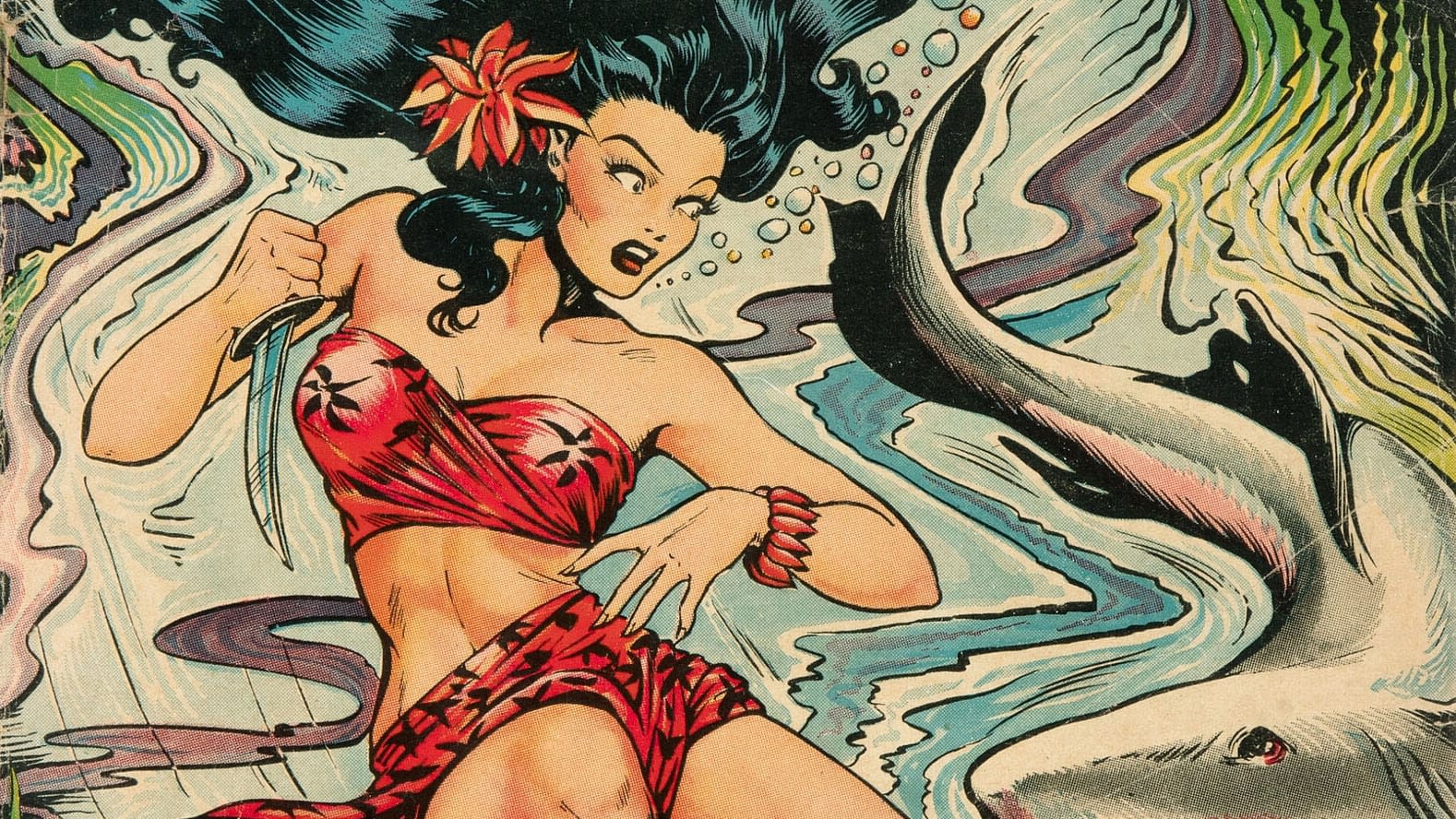
It's not unlikely that Baker's star turn on Seven Seas Comics was intended in part by Jerry Iger as a showcase for Baker's artistic talents, and published by Iger himself during this period at least in part in a bid to showcase the talents of one of his rising Iger Studio star artists to find him higher profile work — including cover art assignments, which never went Baker's way at Fiction House. An artist who became legendary for his cover artwork in particular, Matt Baker had only done six of them before his first South Sea Girl cover, on Seven Seas Comics #3.
In the context of its time frame, Seven Seas Comics can be considered a turning point in Matt Baker's career. The series began about a year and a half after his comics debut on Sheena in Jumbo Comics, and his style had evolved significantly towards the form that would make him a legend in subsequent decades. Baker's work on the character South Sea Girl across all six issues of this series and on the covers of its final four issues was the beginning of a higher profile for Baker's Good Girl artistic skill. His infamous work for Fox Feature Syndicate ramped up just as Seven Seas Comics was concluding.
The Baker and the Fox
The prelude to that ramp-up of Matt Baker's Fox work, and of Fox's Good Girl era, can actually be traced to Blue Beetle. While what happened during Blue Beetle's Holyoke era was a radical departure from what came before, what happened after Fox got it back with issue #31 (on sale around May 12, 1944) is arguably just as strange. It appears that Fox was still trying to take his cues from DC Comics here. Blue Beetle exhibited an unexplained Superman-style level-up in his abilities, seemingly in a bid to regain his stature as a premier superhero in a market that had seen dozens of them come and go by this time. His strength increased dramatically as he was regularly seen lifting cars and other heavy items. He began to seem invulnerable, easily breaking through brick walls and telling an opponent their bullets would be useless against him. Eventually, he even began to fly.
This attempt to take on Superman failed. In August 1946, Blue Beetle (and Green Mask) were halted, and Fox's rising tide of funny animal and other humor titles completely took over the company. Such titles are all Fox Feature Syndicate published for the subsequent eight months. It's an odd decision by Fox, as there were plenty of Disney, Terrytoons, and Looney Tunes titles on the stands every month by this time, and the likes of Cosmo Cat would seem to be a tough sell by comparison. And it seems that Fox regretted it before the end of that eight-month period.
Perhaps prompted by Jerry Iger and Seven Seas Comics, and by the success of Sheena and others at Fiction House, Fox put a new plan in motion, with titles hitting newsstands in April 1947. Blue Beetle resumed with issue #45, touting itself as the "Return of America's No. 1 Hero," but with no apparent editorial changes, so far. More importantly, Zoot Comics #7 (another issue on offer from the Golden Age Good Girl Comic Book Facsimile Collection that catches our eye) featured a radical change from kid's humor comic to Good Girl title, with the debut of Rulah, Jungle Goddess by Matt Baker in an interior story, and a Jack Kamen Rulah cover. Within five months, Fox transformed a line entirely composed of children's humor comics into a line entirely composed of comics with racy Good Girl covers. Blue Beetle was de-emphasized on the covers of his own comic book in favor of beautiful women. Along with Zoot Comics, Jo-Jo Comics and All-Top Comics were likewise converted to jungle adventures.
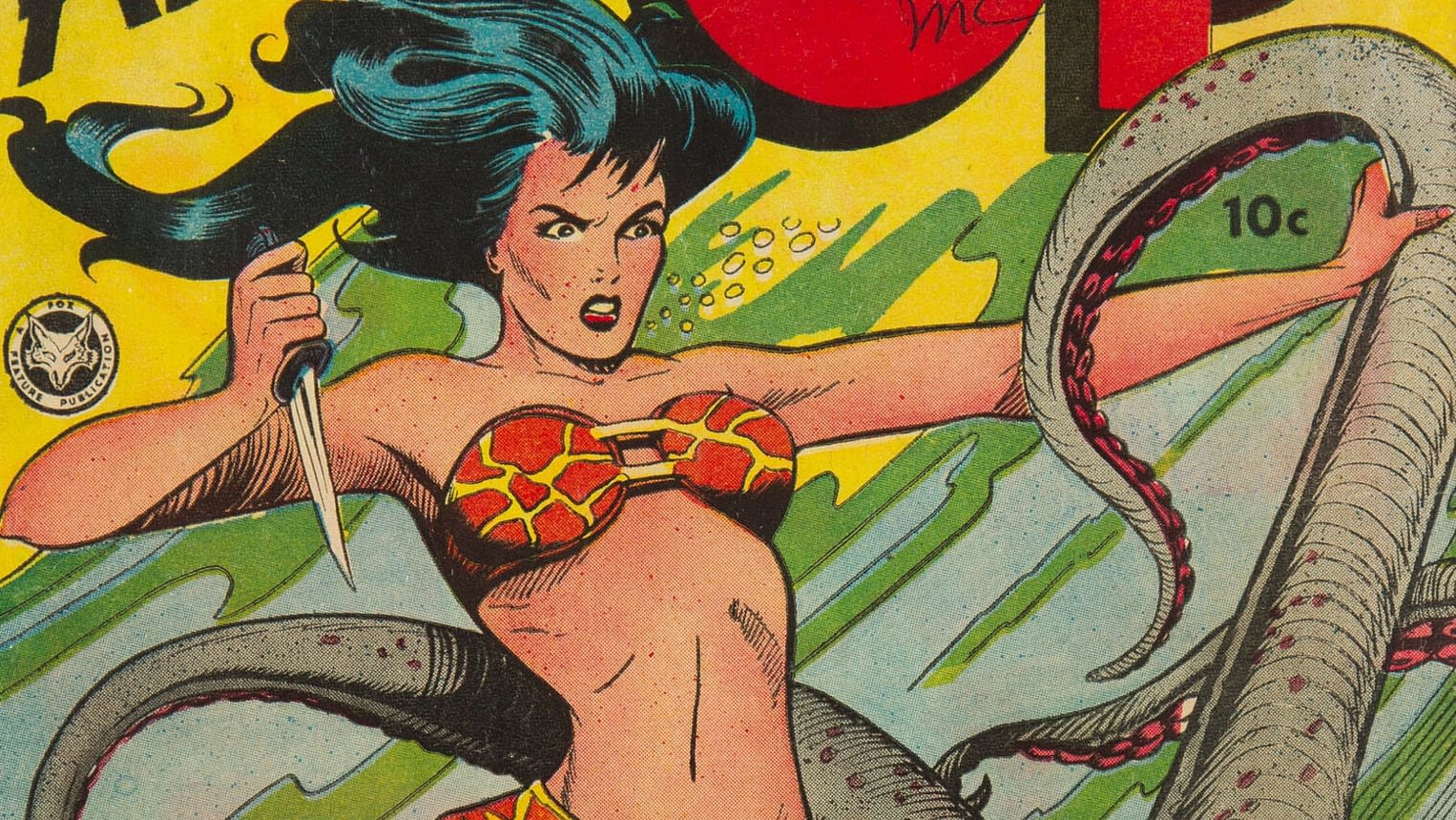
Most importantly, Phantom Lady was introduced to the Fox Feature Syndicate line-up, apparently by arrangement with Iger. Victor Fox seems to have been sold on the notion that Good Girl art was the immediate future of comics and that artists like Baker and Kamen, among others, would help realize it. Fox transformed the funny animal title Wotalife Comics into Phantom Lady with issue #13, where it would eventually become one of the most notorious comic book titles in American history. While many other publishers were edging into Good Girl art territory, Victor Fox was willing to bet his company on the trend and others in play in the comic book industry at that time.
And Fox itself was not the only company he was willing to bet on these trends. On October 3, 1947, a printing plant in Wilkes-Barre, PA, that was originally known as General Printing Co., was incorporated as Central Color Press, Inc. by Victor Fox, seemingly as a prelude to his subsequent acquisition of Potsdam Paper Mills of Potsdam, N.Y. with one paper noting that "The Potsdam plant manufactures newsprint and cover stock, chiefly from reclaimed waste from the binding operations of Central Color Press, Inc., at WilkesBarre, Pa. Additional machinery and equipment are being installed." This was a fascinating integration on Fox's part. As we have noted frequently here, paper shortages lingered long after the end of the war. Victor Fox associate David Korneman testified in front of the U.S. Senate about the matter that same year. Potsdam Paper Mills' specialty in recycling paper also likely explains why so many copies of Phantom Lady #17 were printed on pink paper, a likely side effect of the limitations of Potsdam's deinking process. On July 15, 1950, Central Color Press and Fox Feature Syndicate both filed for Chapter 11 bankruptcy. Potsdam Paper Mills seems to have survived Victor Fox, and was decommissioned in 1974 after having been acquired by another company.
Phantom Lady's Fox Era Fallout
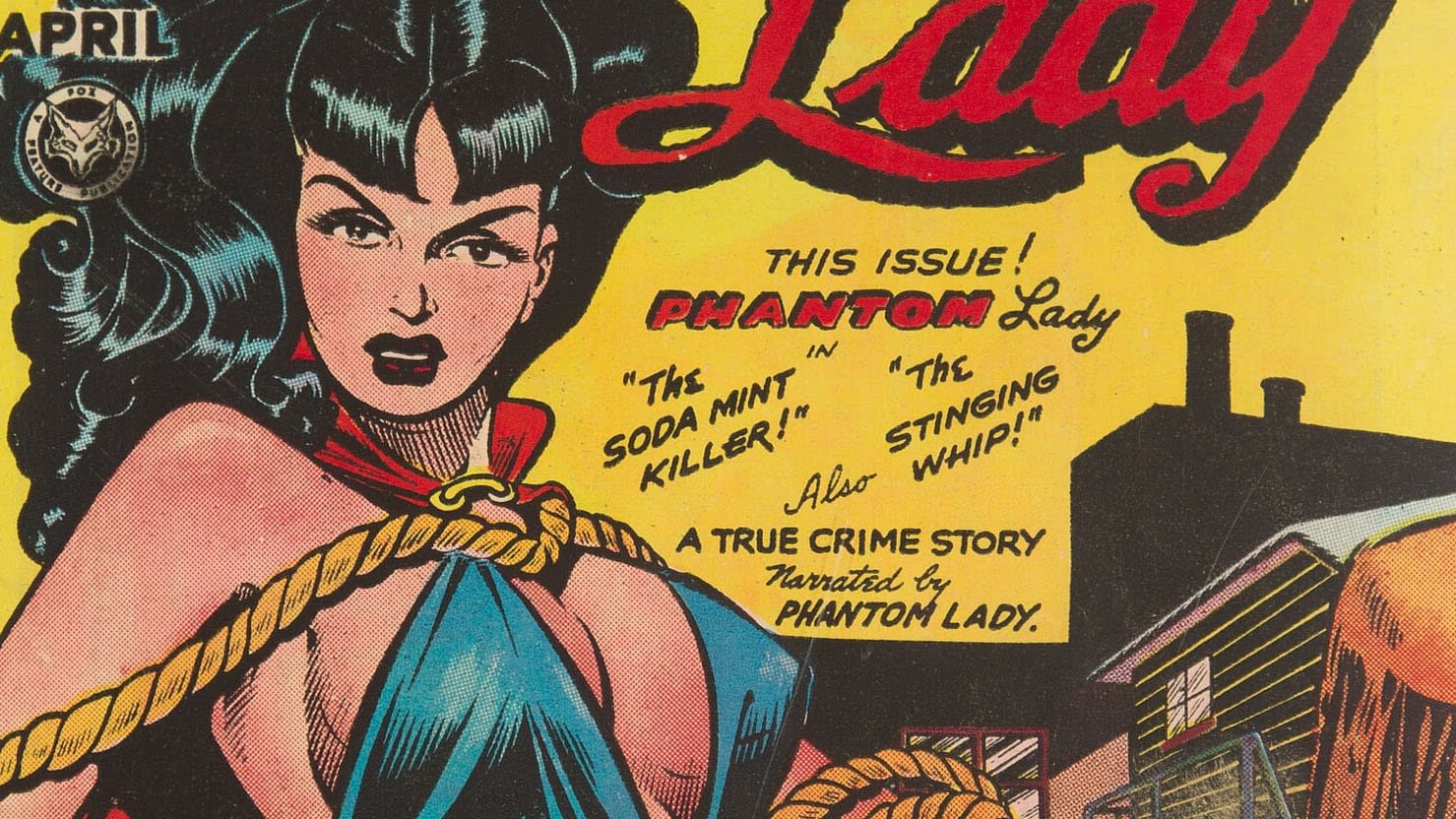
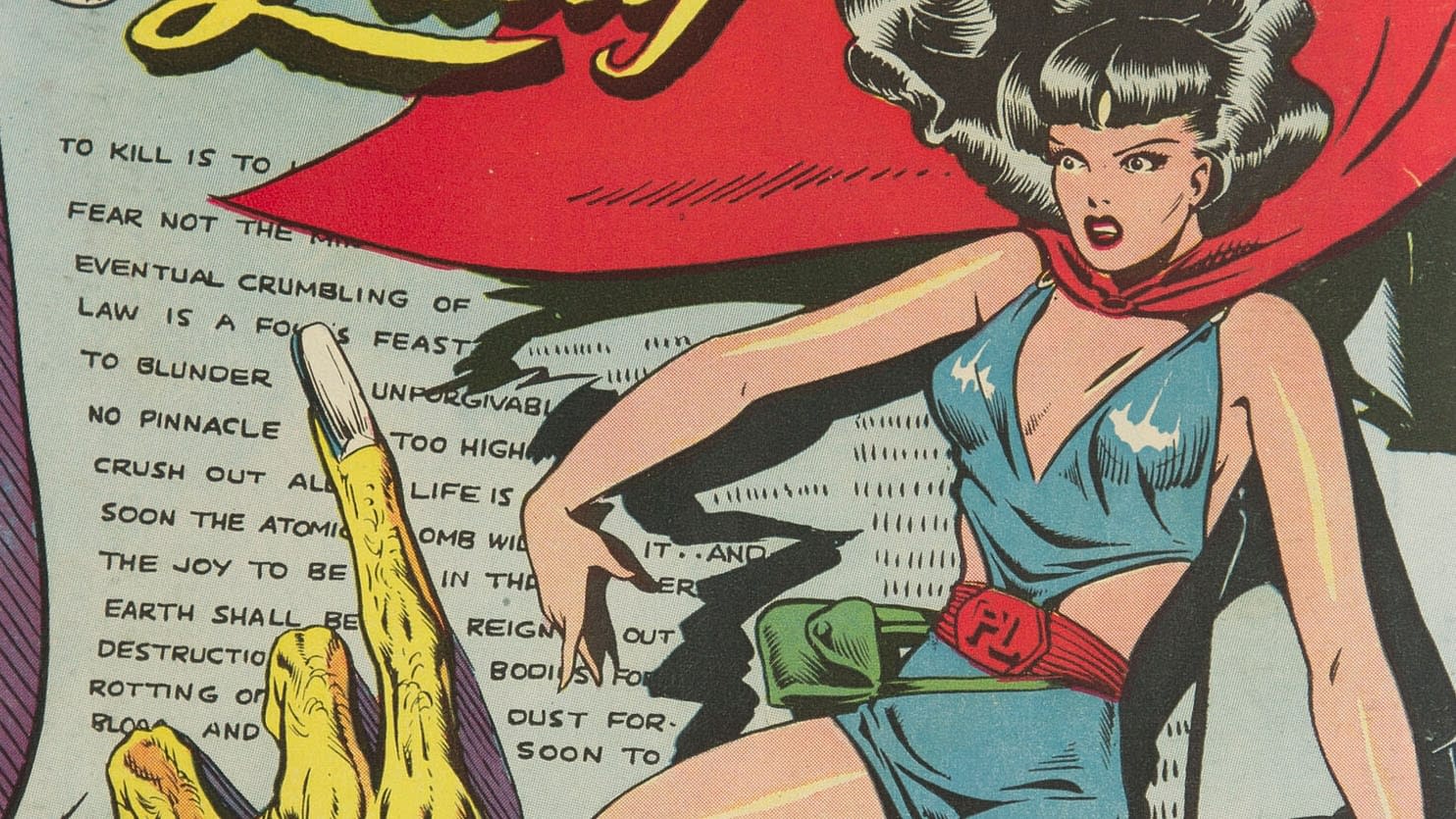
Phantom Lady debuted at Fox with issue #13 cover-dated August 1947, continuing the Wotalife Comics numbering. While the Matt Baker art is, of course, spectacular, Ruth Roche's scripts are a very underappreciated effort to reestablish the character for the post-war era while retaining the super-science flavor of some of the Police Comics series. In the story, Sandra Knight is impersonated by an android created by the villain as part of a scheme of revenge against Senator Knight, who sent the villain's son to the electric chair when he was a lawyer. The series did move towards more of a true crime flavor, with back-up stories that were pure true crime, introduced by Phantom Lady. There were also some noteworthy dashes of horror, such as issue #15's wild "zombie fifth column" created with the ultimate goal of crippling America with the help of Nazi V-2 rockets hidden in South America. Phantom Lady #17 is very true crime-focused, as largely implied by that spectacular Matt Baker cover. The character takes on a protection racket and murder in the lead "Soda Mint Killer" story, and horse race fixing leading to murder in "The Stinging Whip" story. The true crime back-up, "Evelyn Ellis, Queen of the Gangsters," is a tale based on the exploits of a gang that operated in California in the 1930s.
It is again worth noting that it was no coincidence that one of the most infamous comic books in vintage comics history was published at a moment of one of the industry's greatest peril. Phantom Lady #17 hit newsstands around February 1948, and the title was appearing on numerous local ban lists in subsequent months. A New York State statute prohibiting the sale of publications with "pictures and stories of deeds of bloodshed, lust or crime" was under fire while this issue was on the stands. While this was declared unconstitutional by the U.S. Supreme Court in WINTERS v. PEOPLE OF STATE OF NEW YORK (decided March 29, 1948), a number of other states and cities were ramping up their attempts to enforce similar statutes which targeted comic books. And just as importantly, pressure was also being brought to bear on comic book distributors. In response to this sort of outrage, several industry publishers formed the Association of Comics Magazine Publishers and announced their code guidelines in June of this year, the industry's first attempt at self-regulation.
Around this time, Fox seemed to hedge his bets by ramping up his titles in other genres, including more crime and a dizzying array of little-documented romance comics. This was no doubt part of his strategy to leverage his acquisitions of a printing plant and paper mill. When Wertham's Seduction of the Innocent was published in 1954, he prominently featured an image of the cover of Phantom Lady #17, calling it "a sadist's dream," among other things. There are many titles and issues I've discussed here on the Golden Age Good Girl Comic Book Facsimile Collection beyond the ones already called out, such as the wild return of Phantom Lady in 1954/1955 by Ajax-Farrell, Crimes by Women, and Famous Crimes #1, a comic book that infuriated the Mayor of Indianapolis in 1948, and, well… I could go on at length. There will be much more on the subject in the coming weeks.

Enjoyed this? Please share on social media!



Stay up-to-date and support the site by following Bleeding Cool on Google News today!