
 About
About 

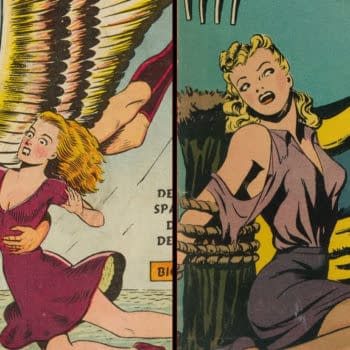
"I did corrections on things, insane corrections." Patrick Lamar complains about comic publishers and page rates in court in 1941.
Posted in: Comics, Golden Age Good Girl Collection, Vintage Paper | Tagged: Ace Magazines, Lloyd Jacquet
Super-Mystery Comics: The 1940 Fight Over Comic Book Page Rates
"I did corrections on things, insane corrections." Patrick Lamar complains about comic publishers and page rates in court in 1941.
Article Summary
- Super-Mystery Comics from Ace Magazines introduced Magno the Magnetic Man, a clear precursor to Marvel's Magneto.
- A 1941 lawsuit filed by packager Patrick Lamar reveals a bitter 1940 dispute over comic book page rates with Ace Magazines.
- Funnies Inc. founder Lloyd Jacquet testified that top-quality Golden Age comic art commanded up to $20 per page (from the studio to the publisher)
- The jury settled the Super-Mystery Comics page rate dispute at $9.69 per page, a verdict upheld on appeal.
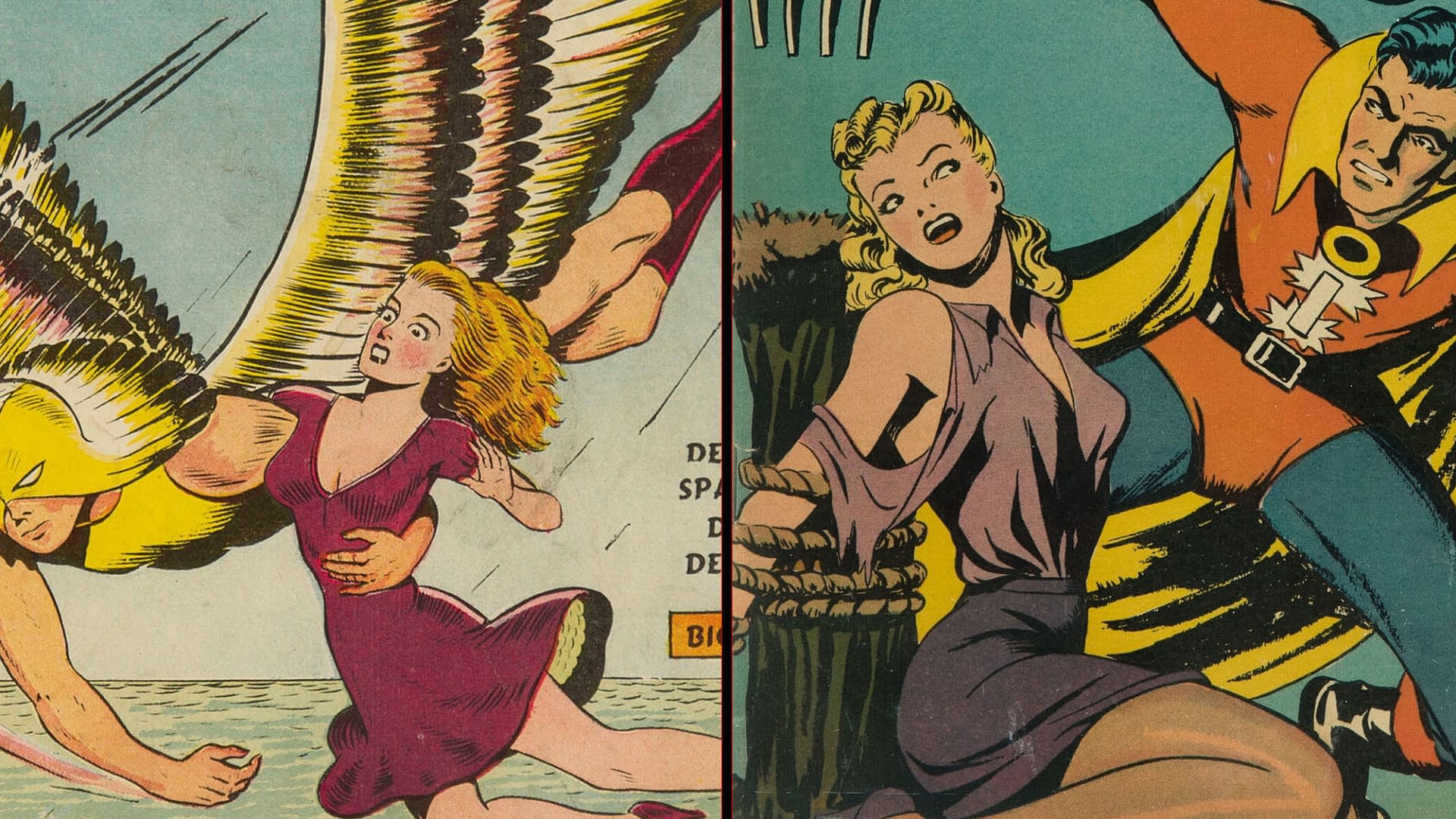
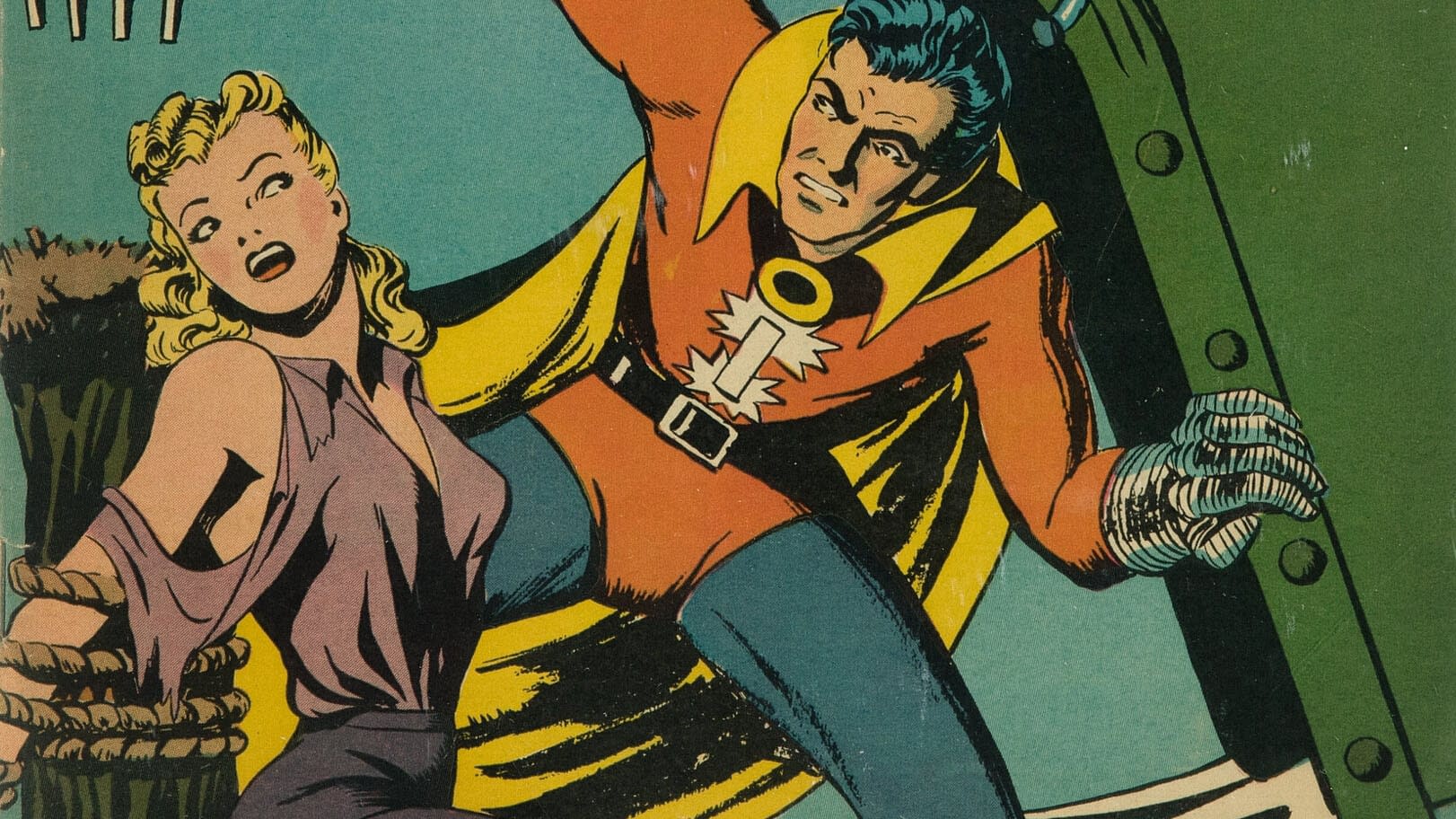
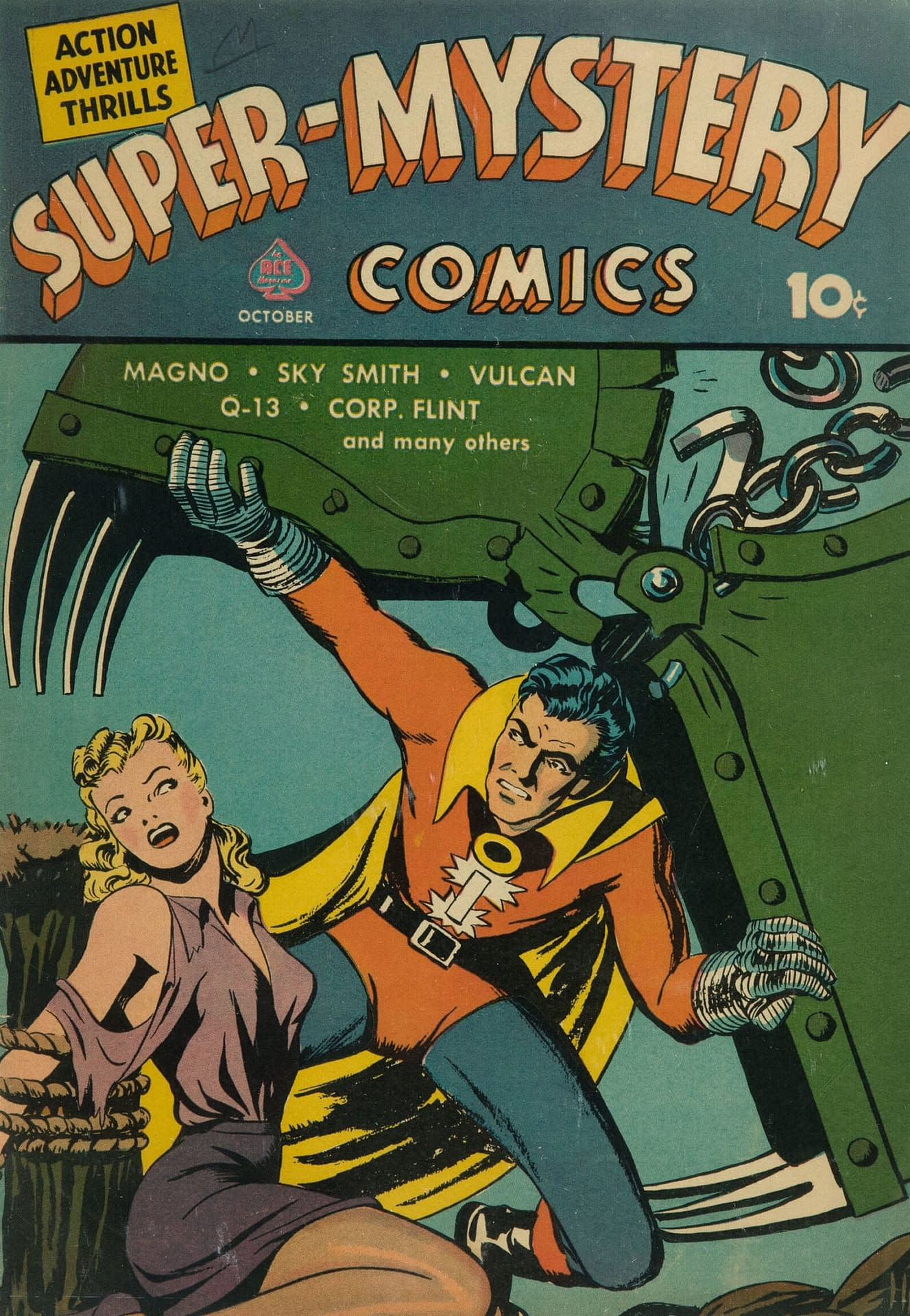
An obscure comic book series from the perspective of modern collectors, Super-Mystery Comics was the most successful early comic book title from Aaron A. Wyn's Ace Magazines, a publisher who is best remembered for his paperback publishing endeavors. The title lasted 48 issues from 1940 to 1949, launching as a superhero series, then veering into crime and horror as those genres rose in the late 1940s. It's not an easy run to put together, and we've known collectors who have had a tough time assembling Ace titles such as this and Four Favorites. Obscure as it is, the title deserves to be better known among modern collectors. The early series introduced Magno the Magnetic Man, and if you're familiar with Marvel's Magneto, you know exactly what to expect from Magno: "Seldom has the world seen anything so strange as the powers possessed by Magno — the Magnetic Man. Mysterious and mighty, Magno is able to draw to himself anything of metal. In addition, he can hurl himself through space, attracted by anything metallic. With such powers, Magno could rule the world. Instead, he chooses to devote his life to fighting evil of all kinds."
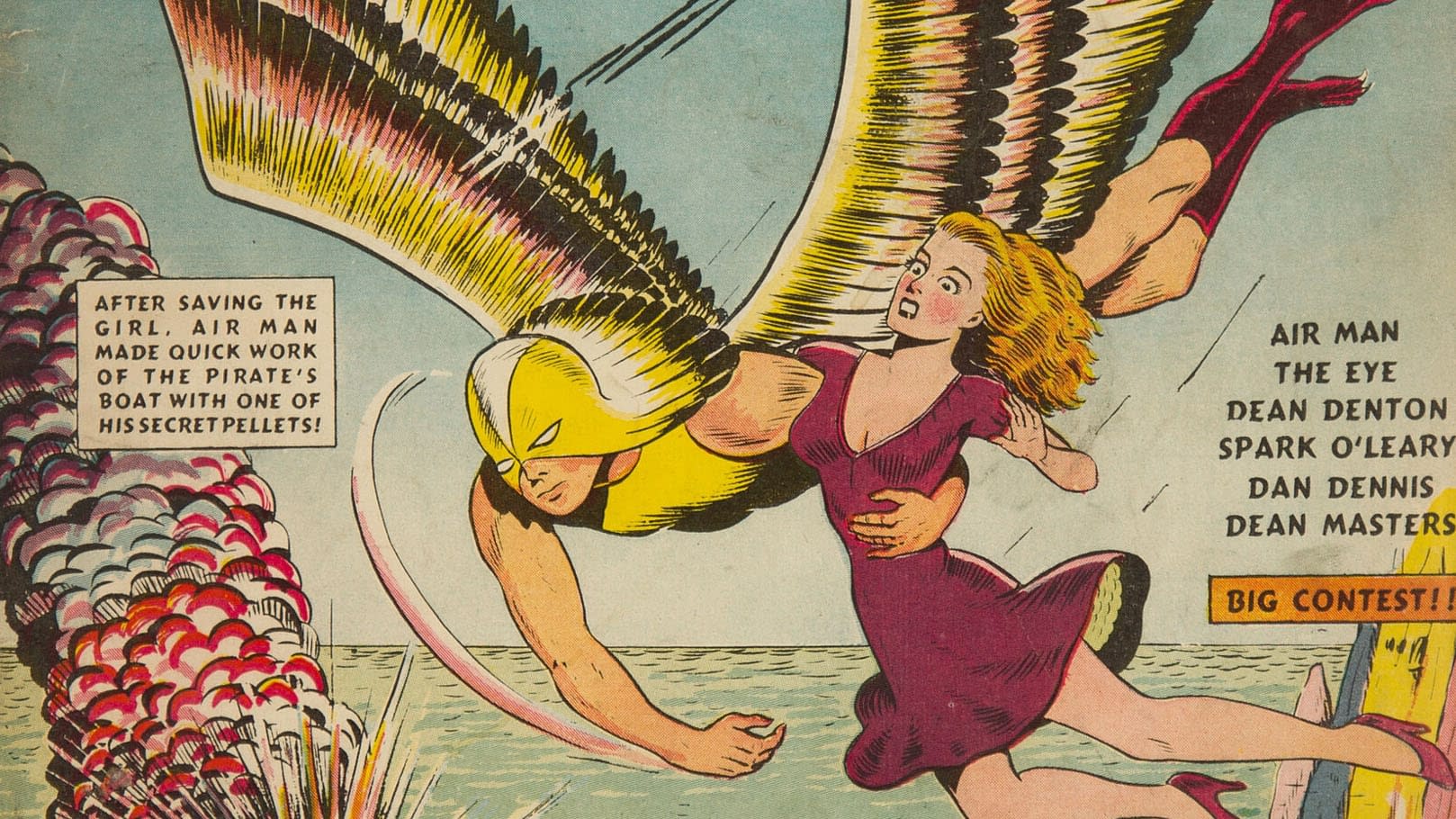
That's interesting on the face of it, but on its own, that wouldn't necessarily qualify the history behind Super-Mystery Comics as the subject of the kind of deep dive that Pixelmon Media asked us to do with some of the comic books featured in their Golden Age Good Girl Comic Book Facsimile Collection Kickstarter. Even so, when we spotted Super-Mystery Comics #3 on their list of facsimile reprints, it was immediately one of the issues we wanted to focus on. Like a lot of issues we've talked about in this deep dive series, it's a comic book with a number of stories to tell, but the stories behind Super-Mystery Comics #3 are even more deliciously unknown than usual. A lawsuit involving work done for Super-Mystery Comics, Lightning Comics, and Sure-Fire Comics, and filed by little-remembered comic book production studio packager Patrick Lamar, lays out a 1939-1940 dispute over page rates in fascinating detail. And the situation was so frustrating to Lamar that he seems to have quit comics shortly after resolving this lawsuit. Super-Mystery Comics #4 and Sure Fire Comics #4 may be his last work in comics.
The Super-Mystery of Patrick Lamar
Aaron A. Wyn isn't as well remembered as some other comic book publishers of the vintage eras, like DC Comics founder Malcolm Wheeler-Nicholson, Wilford Fawcett, Marvel's Martin Goodman, and others, but Wyn's history is still reasonably well understood by researchers in this area. Wyn and his sister Rose Wyn had been involved in pulp publishing since about 1928. The comic book line that began with Super-Mystery Comics in 1940 lasted through 1956 and spanned 668 individual issues over 48 titles. Two of the later romance titles, Real Love and Glamorous Romances, lasted for more issues than Super-Mystery Comics at 52 and 50 issues, respectively. The publisher also had a noteworthy Pre-Code Horror line, including Web of Mystery, The Beyond, Baffling Mysteries, and The Hand of Fate. Of those 48 total series, the publisher released a dozen titles that lasted over 25 issues each, an impressive feat by the standards of the Golden Age and particularly for a publisher that isn't really remembered for comic books. In 1953, Aaron A. Wynn launched Ace Books with the instigation of editor Donald A. Wollheim. Currently an imprint of Penguin Publishing, Ace Books has become one of the best-known publishers and longest-running science fiction/fantasy publishers in the United States.
But while Aaron A. Wyn's history is at least understood in broad strokes, Patrick Lamar was a complete unknown before his 1940 lawsuit against Ace Magazines surfaced. Lamar's testimony on the stand during this November 1941 trial before a judge and jury gives us a bit of a starting point into understanding his history. He tells the court he'd been a commercial artist for 14 years and that prior to this Ace Magazines deal, he'd done work for DC Comics' Harry Donenfeld, presumably in the late 1930s, supplying individual features rather than whole issues. He also noted during testimony that while he had a number of quotes out to other publishers, he had yet to do additional work in comics beyond working with Wyn and Donenfeld. Lamar's May 1989 obituary supplies numerous other details. Patrick Lamar graduated from the Pratt Institute in 1930, then apprenticed under commercial artist Carl Mueller in New York City. He operated his own art studio in the 1930s and 1940s, which seems to be a reference to the production studio he briefly ran in comics. He then worked as an art director for The Police Gazette and publishers such as Stearn Publications and Volitant Publications, eventually becoming an art director at Doubleday.
The Art and the Deal
The dealings between Lamar and Ace were complex from the beginning. The crux of the situation was that Lamar wanted a long-term commitment from Ace to provide them with a full-issue service or nearly so, and in return, he would set what he considered a bargain rate for art at around $9.75 per page (his price to the publisher). By the time Lamar had completed four issues of material, things had become contentious, the particulars of what was to be provided had become complicated, and renegotiations were attempted. Lamar became frustrated and began discussing, or outright billing, at full-issue art rates ranging from $12.00 per page to nearly $20 per page. The entire process failed miserably at that point, leaving additional issues worth of artwork submitted but unpaid. The art rate was the key component of the parties' contention, whereas other aspects of the work, as we'll see in the next section, were largely considered industry-standard rates and agreed upon.
It seems clear from the posturing on both sides that Lamar's cost from the artists per page vs what he was able to charge Ace per page was likely his most substantial profit margin on any given job, and became the major pressure point that caused the dispute between the parties. Of course, there were other factors. On the stand, Lamar also complained that he had been forced to make a large number of art corrections: "I did corrections on things, insane corrections. [Ace were] sort of victims of their imagination, what they thought was the right thing to do on the job. [Aaron A. Wyn] is a publisher, not an artist."
Q. Tell the jury your conversation?
A. My conversation included all these things. We had been bickering as to the price of the work being done in this book. Finally Mr. Wyn said, "let us cut out the bickering and set a fair price for the work that you are doing," so we sat down and set a fair price, but naturally the price that was agreed upon was contingent—Defendants' Counsel: I object to that.
The Court: What did he say?
By Plaintiff's Counsel:
Q. If you discussed the price tell the jury your conversation?
A. The price we agreed upon mutually after conversation had been six hundred and twenty-five dollars per issue, but of course that price was contingent upon my doing work indefinitely which we figured would be for twelve issues. Naturally if I had expected to do the work only for one issue I would not accept six hundred and twenty-five dollars, I would naturally want more money.The Court: What did you say to him?
By Plaintiff's Counsel:
Q. What did you say concerning that point where you wanted to do twelve issues for six hundred and twenty-five dollars, what did you talk about with Mr. Wyn?
A. Well, we naturally agreed upon this particular price because they agreed to give me work on these books for twelve issues.Q. Did they give you twelve issues?
A. No, after that conversation I had only received four issues at that particular price that we had agreed upon, and then they kept me waiting a month for the scripts, every week I was supposed to be receiving the scripts to work upon.Q. What is the script?
A. The script is the story.By the Court:
Q. You only received four issues; was anything said in case you were not to receive twelve issues?
A. No, nothing was said as to that.By Plaintiff's Counsel:
Q. Now, after these conversations—this was in June, 1940, wasn't it?
A. That's right.Q. After these conversations did you furnish any art work to the defendants?
A. Yes, four issues.Q. Of what did it consist?
A. Complete books without the scripts, which they supplied me—the scripts and the coloring, which they supplied me.
Going Rates for Art, Color, and Script
One of the most striking elements of this dispute is that all parties who testified, which included Centaur's Joe Hardie, Aaron A. Wyn, Funnies Inc.'s Lloyd Jacquet, and Lamar himself, generally agreed that the going rate for a comic book script was $2.00 per page, and the going rate for color (meaning color guides) was $0.50 per page. Lettering was also treated separately here (apparently called "blurbs" in the exchange below), as were title page designs, inside front cover designs (editorial matter in this case), a two-page text story, "two cover designs," which almost has to be cover rough concepts based on the likely amount involved in this particular example. Again, the key contention in the dispute was how much should be charged for finished art, with anything other than finished art, script, and color guides considered so incidental that it wasn't broken out in extensive testimony throughout the case. The logistics of having the publisher provide the scripts to avoid a step in the approval process were also discussed, but without any particular contention — except to note that it could delay the process in other ways.
Further, it seems to be generally assumed, and explicitly stated at a couple of points in the testimony, that when "the artwork for a comic book" is discussed, unless noted otherwise they're referring to 64 pages of finished art, and that doesn't include the cover. There's a further implication that it was not uncommon for Ace to obtain some work directly, outside the studio packager Lamar. Taken as a whole, the lawsuit generally seems to imply that Lamar was trying to keep the cost he charged Ace for finished art above the $ 9-per-page range, and how much above that mark, over the long term, was the point of contention. Note that what he paid the artists for the work, minus his cut, is a separate issue. Finished art page rate pricing with a floor in that range seems to be the focal point of the entire thing, though this is unspoken throughout. But at one point elsewhere in the testimony, it was revealed that Ace agreed to pay Lamar a separate $70 -per-issue flat rate cut for delivery rather than set a standard for paying him a higher page rate. In the case below, if we based calculations on a theoretical $9 page rate for art and the established rates for script and color, that would leave only $13.50 left over for cover roughs, numerous title treatments, and lettering. That implies a lettering rate of pennies per page.
Q. Are there 15 pages of comic strip features in that book for which Lamar did not furnish any script?
A. Yes, sir.Q. Will you tell us how it came about that 15 of those page, that the artwork for those pages, was done without script, and how it came about that the other 47 pages of artwork were done with script?
Plaintiff's Counsel: I object to the question.
The Court: Sustained.
Defendants' Counsel: Exception.
Q. Will you tell us what that bill says is the cost or charge for the 47 pages of script that Lamar did make?
A. Two dollars per page, equalling $94.Q. Will you tell us whether there appears an item on that bill for coloring?
A. Yes.Q. What is that?
A. 64 pages, $32.Q. What was the charge that Lamar made for rendering the artwork on that June issue of Sure Fire, including 47 pages of script and 64 pages of coloring?
A. That's hard to determine because there are so many other charges in here.Q. What is the total bill?
A. The total bill is $689.Q. What else did that include?
Plaintiff's Counsel: I object to that question.
The Court: We have gone so far and you were silent; we may as well finish it up.
A. That includes 34 pages with blurbs, 26 pages with blurbs, the second cover, includes double-page script, includes two cover designs which we had made and the color guide for same, the titles for seven strips and the headings for same, 64 pages of coloring, and 47 pages of script at two dollars a page.
Q. The total for that was $689?
A. $689.
The Testimony of Lloyd Jacquet
The founder of Funnies, Inc., Lloyd Jacquet, is one of the most pivotal figures in comic book history. He was Malcolm Wheeler-Nicholson's first editor on the first DC comic book, New Fun Comics. His Funnies Inc. provided the contents of Marvel Comics #1, the first Marvel comic book. He was the art director/editor for Centaur and, overall, a foundational figure of the Golden Age of comics. He gives some of his background on the stand here, with counsel reeling off questions about his expert qualifications until the judge shuts him down. They then get to the heart of the matter, with Jacquet implying that Lamar's work was of poor quality and worth only about $600 for 64 pages of art, or about $9.38 per issue. Jacquet then divulges that he has charged comic publishers up to $20 per page for top-quality artwork. Jacquet's statements are interesting here, because we know from the documentation of the Marvel Comics #1 Pay Copy that Jacquet only paid out $8 to $10 per page for the art for most of the contents of that issue, which includes some of the most famous work in comics history by Carl Burgos and Bill Everett, just months before the window of contention for this lawsuit began with Super-Mystery Comics #1. Presumably, he charged Marvel's Martin Goodman more than that rate and then took a cut for Funnies, Inc., but how much more is an interesting question in the context of how he testified during this trial. This is a particularly interesting trial testimony moment, as plaintiff's counsel adeptly guides Jacquet into supporting Lamar's later significantly larger page-rate asks over the defense's objections.
Q. What is your business?
A. My business is Funnies, Incorporated, which is a company that supplies the material for publications of comic magazines exclusively.Q. When you say material I assume that you mean that that includes the art work, the script and everything else that goes into the making up of these books?
A. That's right.Q. Now, your prices are the same throughout for every company that you furnish this art work for, aren't they?
A. No, sir, they are not.Q. They vary, don't they?
A. That's right.Q. And you will charge one company more and one company less for the same type of work, isn't that right?
A. No.Q. Let me ask you this, you have one price, is that it, for all the work that you do?
A. No, sir, it depends on the service that's rendered, and on the quality of the service.Q. Well, now, you were talking about the same type of work, were you assuming that the work is of a uniform quality?
A. We don't supply work of a uniform quality.Q. You mean your quality varies?
A. That's right, according to the requirements of the publisher.Q. Now, what is the highest quality of work that you do? Will you describe what that consists of?
A. Consists of the finest art work that we can produce.Q. It consists of workmanship, isn't that true?
A. That's right.Q. In other words, the type of labor that goes into it, the type of the artist's ability that goes into this work, determines what its reasonable value is?
A. That's right, insofar as art work is concerned.Q. I am talking only about art work here, and consequently the reasonable value of the art work involved in one of these comics would depend primarily upon the quality of workmanship involved?
A. Yes, it would, but not entirely. Primarily, but not entirely.Q. Primarily there would be other things such as the originality and so forth, but the type of the workmanship is the most important thing. Do you know Mr. Lamar?
A. No, sir.Q. Did you ever hear of him?
A. No, sir.Q. Let me ask you this—
Defendants' Counsel: I would like to ask your Honor to instruct the plaintiff not to make any comments.
The Court: Yes, sir. (To plaintiff:) You sit over there, you talk too much.
Q. As a matter of fact, you have done this type of work and charged as much as twelve or fifteen dollars a page, is that right?
A. No, sir, not this quality.Q. Well, of course, quality is a matter of opinion, isn't it?
A. That's right.Q. You might think something is very good and another person, an artist might disagree with you, say "I don't like that"?
A. That's right.Q. So that is a matter of opinion?
A. That's right.Q. But you have furnished what you consider good quality art work for comics such as involved in this case for as much as twelve and fifteen dollars a page, haven't you?
A. A great deal more.Q. How much more?
A. Probably twenty-five to thirty percent more.Q. In other words, that amounts to $20 a page?
A. That's right.Q. So that if you did a book consisting of 64 pages of the highest quality workmanship, how much would that come to on your figure?
Defendants' Counsel: I don't see how that is material to the issues here.
The Court: Overruled.
Defendants' Counsel: Exception.
A. 64 times 20, that is $1280.
Q. So the reasonable value of a book of 64 pages with the highest quality workmanship might come to well over $780?
A. Of the finest quality it would.Q. That's the very best?
A. That's right.Q. It might come up to about $1240, right?
A. I think I said $1280.
The Jury Splits the Baby
There are a number of pretty fascinating implications in Jacquet's testimony. Most importantly, taking it all at face value, and assuming Jacquet wasn't taking a 50%+ cut for himself, it would seem to imply that market rates rose and began to vary significantly between 1938 (also factoring in the Superman Check data point) and 1941, which, of course, is unsurprising. There's also an unspoken assumption here that Lamar was aware of what the top market art rates were when he got fed up and quoted full-issue art numbers to Ace, ranging from $750 to $1250 (which is close to what Jacquet mentioned on the stand), as their deal was falling apart and tempers flared. Lamar ultimately asked the court for a sum based on a $10 per page rate, while defense witnesses Jacquet and Hardie testified that the work was worth about $9.38 per page. The jury split the baby at $9.69 per page, and the verdict was upheld on appeal. The Pixelmon Media Golden Age Good Girl Comic Book Facsimile Collection Kickstarter ends in 48 hours as I type this, and we covered some good ground over the past five weeks, but there's so much more we could have written about as well: some great Jungle Comics, Planet Comics, Terrific Comics #5, and lots of L.B. Cole stuff, a lot of fun Fox stuff, including the rare Wonderworld Comics #28 which is likely going to drive some collectors to support this Kickstarter all on its own. Even so, Super-Mystery Comics #3 and Keen Detective Funnies #23 are two of the most fascinating issues involved.

Enjoyed this? Please share on social media!



Stay up-to-date and support the site by following Bleeding Cool on Google News today!