
 About
About 

Another deep dive into the Golden Age Good Girl Comic Book Facsimile Collection Kickstarter, with the underappreciated importance of Eerie Comics #1.
Posted in: Comics, Golden Age Good Girl Collection, Vintage Paper | Tagged: Avon Publications
Eerie Comics #1 and the Chain Reaction That Became Pre-Code Horror
Another deep dive into the Golden Age Good Girl Comic Book Facsimile Collection Kickstarter, with the underappreciated importance of Eerie Comics #1.
Article Summary
- Eerie Comics #1 is recognized as the first horror comic book of the Pre-Code era, shaping the path of comic book horror.
- The issue reflects shifting cultural fears, with stories inspired by atomic age anxieties and real-life postwar events.
- Avon's role in pulp and comic publishing connects Eerie Comics to broader industry trends and trademark battles.
- Pre-Code Horror blossoms in the late 1940s and early 1950s, with Eerie Comics #1 igniting a genre-defining chain reaction.
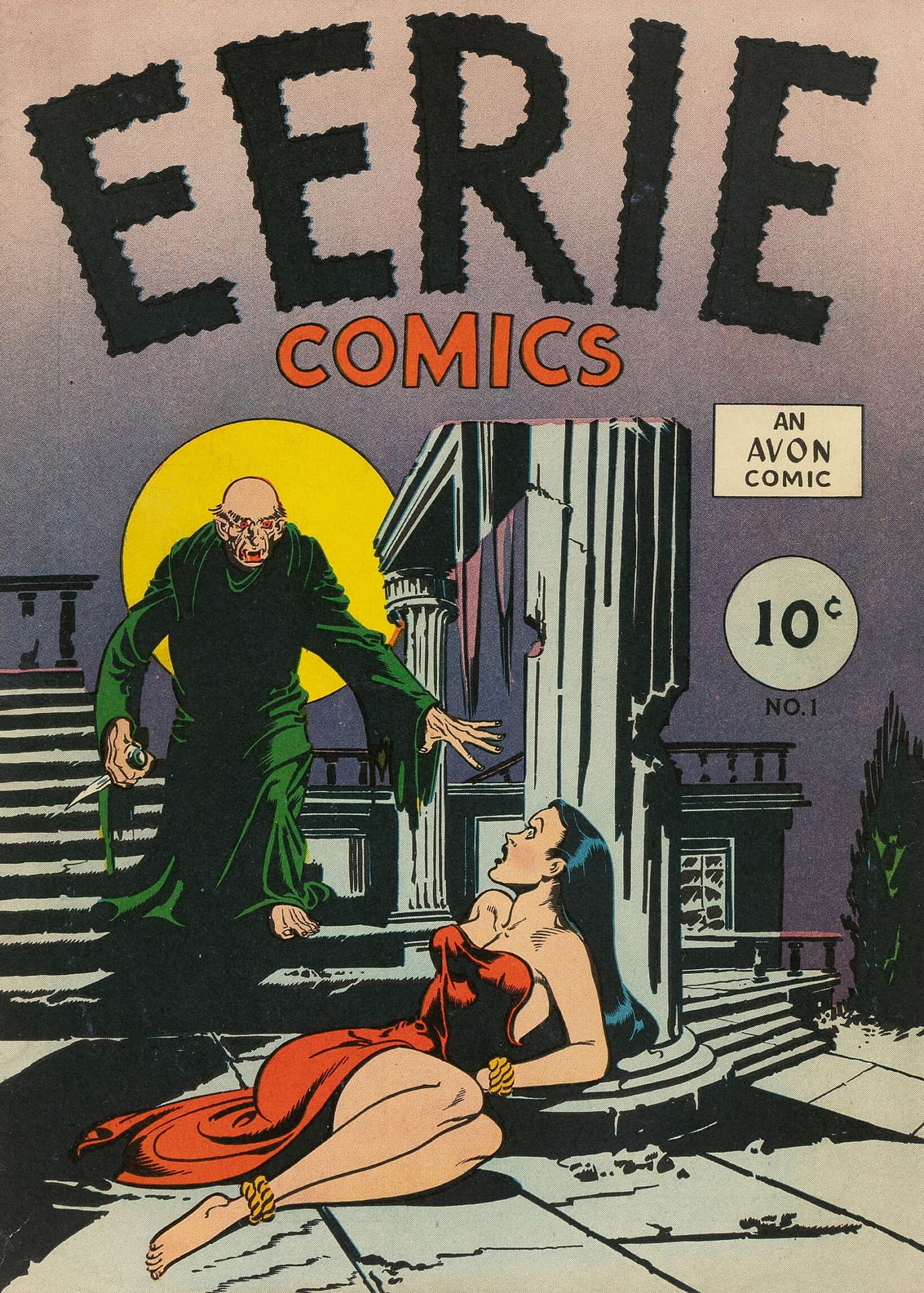
Every once in a while, doing research like this on comic book history shifts our perspective on how that history fits together. While Avon's Eerie Comics #1, cover-dated January 1947, is considered the first all-horror comic book, it is widely understood that it is not the first comic book horror of the Golden Age. There are many comics before it that have stand-out horror covers, and even some that tiptoe up to the line of having a horror focus with their interior stories. While it is more clearly recognizable as the first horror comic book of the Pre-Code era, it might be easier to understand it as the first horror comic book of the post-WWII years and a true harbinger of the comic book horror to come.
Eerie Comics #1 rather sneakily represents horror as transformed by a world traumatized by World War II and the dawn of the atomic age. It was an era of emerging realities that were difficult to confront, changing the nature of our monsters and our fears. When Bleeding Cool's Kaitlyn Booth interviewed Sarah Michelle Gellar recently, she had a lot to say about the nature of horror, noting, "Genre was created to answer the questions that either we don't have the answers to or that we don't want to accept the answers to. And to me, that's where creativity really can live and blossom."
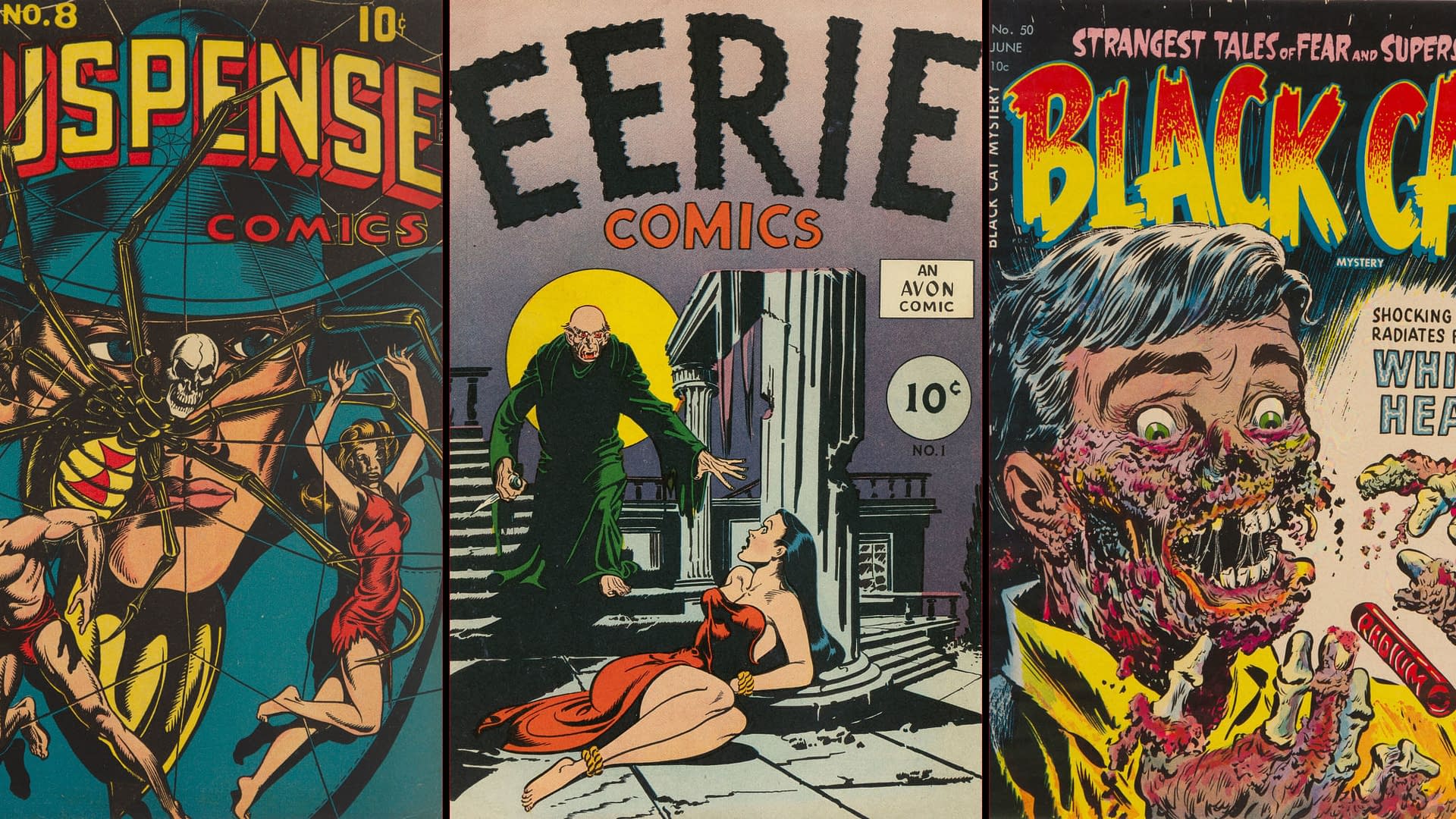
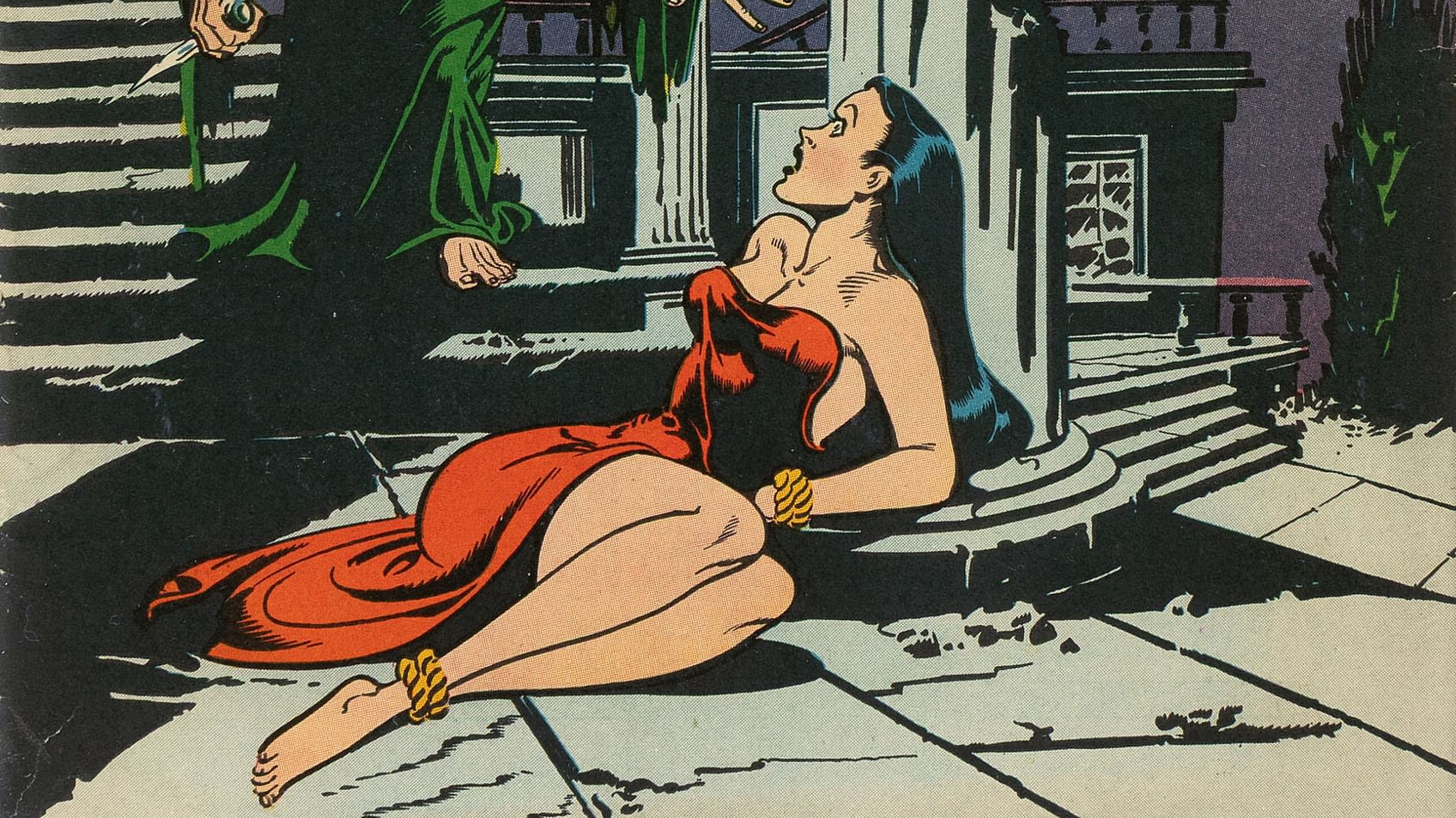
That's exactly what's happening in Eerie Comics #1, and it's a fundamental component of what came next. It's more than a little deceptive in that regard, because the nicely-rendered bondage cover by Bob Fujitani looks more like gothic horror than the Pre-Code Horror imagery that would eventually emerge. The story content also kind of sneaks in references to the different era it is reacting to. But there's a story in this issue with echoes of the Manhattan Project's Enrico Fermi. Another story here was likely written while details of the ritualistic cannibalism of the Chichijima incident were hitting newspapers, and shows that influence in the context of the post-war era. These were the kinds of stories emerging in response to difficult-to-answer questions, and while this single issue didn't spark an immediate boom, it did set off a chain reaction that eventually became most recognizable in EC Comics' horror and science fiction titles. Along the way, titles ranging from Harvey's Black Cat Comics to Stanley Morse's Weird Tales of the Future and countless others developed this unique brand of horror, page by page.
This week's subject was another case of having a hard time choosing exactly which area to focus on, after Pixelmon Media recently asked us to talk about some of the comic books involved in their Golden Age Good Girl Comic Book Facsimile Collection Kickstarter. On the horror front, we initially thought we might start with Lawbreakers Suspense Stories #11, featuring an almost unbelievable severed-tongue cover by Lou Morales. That could be another post all its own, but when Eerie Comics #1 can be seen as less of a one-off outlier and more an anchor point for what followed in the Pre-Code Horror genre, we knew that had to be the hook. It also serves as a bridge from the discussion of Avon's Joseph Meyers from last week's Crime Does Not Pay saga.
Pre-Pre Code and the Horror of Suspense Comics
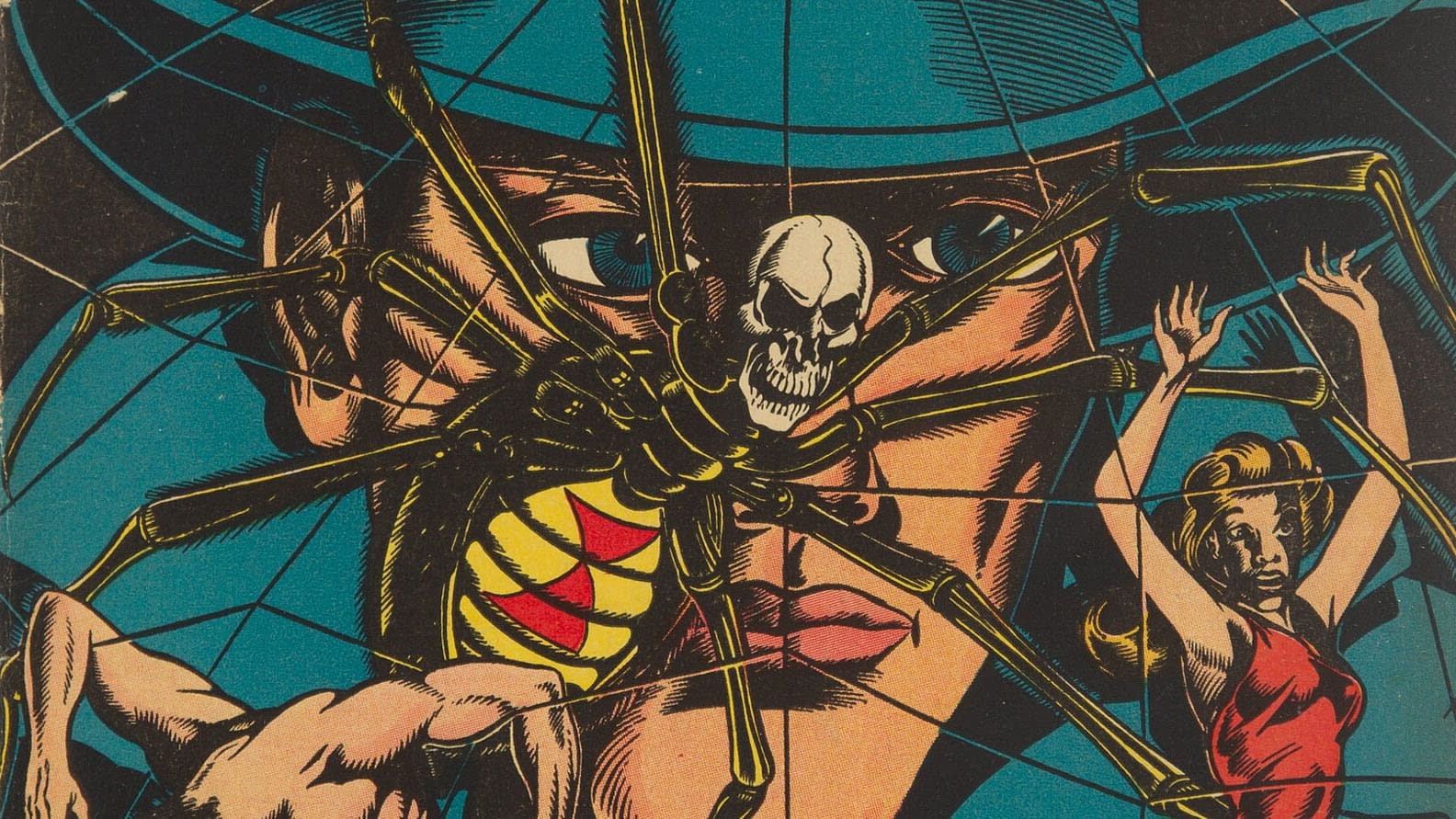
There are a number of places one could start tracing the comic book horror that came before the Pre-Code era. Prize Comics #7 (cover dated December 1940) is an anthology featuring the Frankenstein Monster by Dick Briefer, and the start of that regular feature in the title is one such earlier spark of Golden Age comic book horror. While this take on the character eventually became humorous, it started out as a serious attempt at a comic book version of the classic horror monster and returned to a serious horror character at the peak of the PCH boom. 1945's Spook Comics #1 from Baily Publishing Co. features a horror cover and largely humorous, supernatural-themed content. Front Page #1 from Harvey Comics in 1946, a publisher that would later enter the Pre-Code Horror era in a big way, is a particularly noteworthy early example here. It is mostly supernatural content firmly rooted in the war era (perhaps one story can be considered crime), but characterizes itself as containing "original adventure and mystery stories."
Suspense Comics is one title that's overlooked in this regard. The series rose to infamy after being featured in 1989's original two-volume The Photo-Journal Guide To Comic Books, which showcased photographs of 21,000 Golden Age comic books. In an era during which one can see any published Golden Age comic book cover with a few seconds of Googling, it's difficult to wrap your head around the impact this had on Golden Age comic book collecting three decades ago. Of course, Suspense Comics #3, with its now-legendary Alex Schomburg cover, is infamous for being prominently featured in the Photo-Journal Guide, bringing it to the wider attention of collectors, sparking a frenzy to unearth copies, and sending prices into the stratosphere based on Schomburg's cover art. Interest in the entire Suspense Comics series, which also includes fantastic L.B. Cole covers, got a boost from the Photo-Journal Guide.
Hitting newsstands a few months before the end of the war in 1945, Suspense Comics #8 is one of the most interesting issues here from a horror perspective, featuring a classic, highly sought-after L.B. Cole horror cover. It contains a mix of crime, suspense, and horror stories, with the continuing story of Satan featuring the devil himself in a wrestling match in hell against a gangster. This bizarre tale may have influenced the infamous 1949 Captain America Comics #74, perhaps the strangest and most obscure Captain America comic ever published: Captain America fights the Red Skull in hell. It's an apt symbol of a comics industry moving away from superheroes and towards horror and other genres, which accounts for the Captain America's Weird Tales (emphasis on the Weird Tales) of the title, and the seriously weird tale contained in the story itself. More to the point in the Suspense Comics #8 Satan story, the plot also hinges on a scheme to steal radium, a sign of things to come.
Avon at the Door
Best remembered as one of the early entrants in the American paperback market in the wake of Pocket Books' successful launch in 1939, the roots of Avon Publications trace an interesting path through the history of the cheap mass market collected and reprint edition format in America, with the company eventually branching out into comic books and pulps. Beginning in 1941, Avon's Joseph Meyers played a significant role in shaping that market. But the oldest thread of the company began decades before that under publisher John Stuart Ogilvie, whose company was also largely remembered for reprinting and collecting fiction from other sources. In 1880, Ogilvie entered into an agreement with Street & Smith to exclusively collect and reprint Street & Smith material in a series called People's Library. This arrangement had fallen apart due to royalty disputes by the end of the 1880s, with Street & Smith going on to successfully publish their own reprint collections and also becoming one of America's most successful "thick book" publishers, a format which is, for all practical purposes, the kind of standard paperback format we're familiar with today.
After John Stuart Ogilvie's 1910 death, the firm passed onto his sons Donald and Frank, who seem to have remained in charge of the company until their own deaths in 1936 and 1937 respectively. By this time, the company maintained a back catalog of self-help, "home study" and an array of other non-fiction and fiction titles in clothbound and various formats of softcover editions with a heavy mail-order sales presence. At this point, the company came under the control of Joseph Meyers and his sister Edna Meyers Williams. who transformed J.S. Ogilvie into the paperback publisher Avon. Subsequently, Avon published over 100 comic book titles from 1945 to 1956, most of them extremely short-lived. Avon Books also sporadically published paperback format collections of newspaper comics and similar material throughout that period and continued to do so through the mid-1990s. Avon entered the pulp market in 1947 with Avon Fantasy Reader and Avon Western Reader, later adding titles including Avon Science Fiction Reader, Out Of This World, and 10-Story Fantasy.
It's unclear what specifically prompted Avon to publish Eerie Comics #1, with an eye towards it becoming a series (the indicia states quarterly publication). It's not unlikely that Joseph Meyers was inspired to this by editor Donald A. Wolheim's pitch for the Avon Fantasy Reader pulp digest, which would launch a month after Eerie Comics #1 and contain plenty of horror. At least one cover from a 1947 issue of Avon Fantasy Reader would be borrowed for an issue of the Eerie comic series years later. But for that initial 1947 release, like over 50% of Avon's titles, despite being listed as a quarterly, the Eerie Comics series would only last for one issue.
There are at least two stories in Eerie Comics #1 that subtly signal the beginning of a change from what had come before. Chief among them is Dead Man's Tale, by an unknown writer with art by Jon Small and George Roussos. In the story, a man has come into possession of a substance that he needs more of and approaches an experimental chemist named "Fremi", a seeming reference to physicist Enrico Fermi. He needs Fremi to enable the creation of "the most wondrous potion of the universe", which our protagonist believes will make him the most powerful man in the world. References are made to the need to encase this substance in a concrete container and to the disastrous consequences of handling accidents.
Pulp writer Henry Kuttner provides the stand-out story of the issue, The Man-Eating Lizards, with art by Joe Kubert. In this story, U.S. Airmen on a survey mission crash-land near an island in the Pacific, are captured, and face becoming victims of a cannibalism ritual by the islanders. This seems to be a reaction to the Chichijima incident, which would have dominated the news at the time Kuttner was writing this story. During that period, U.S. Navy War Crimes Trials were being held in Guam, including those of Japanese troops who confessed to the torture, execution, and cannibalization of U.S. Airmen after their planes were shot down and crashed near the Bonin Islands.
While Eerie Comics #1 (1947) is considered a one-shot, when horror comics were later doing well, Avon relaunched Eerie in 1951. The title ultimately became one of their most successful comic book series, running 17 issues. But the market was quickly becoming crowded and competitive, and publisher Ziff-Davis soon released a comic book called Eerie Adventures. Avon then sued Ziff-Davis for "infringement of its rights, trade name and title to the word 'Eerie,' and with unfair competition."
In Avon Periodicals, Inc. v. Ziff-Davis Publishing Co., the court stated that Avon did not have a monopoly on the use of the word "eerie," but that based on the notion that "both magazines were of similar editorial content, size, format, price, distribution, frequency, etc.," the court granted a permanent injunction that restrained Ziff-Davis "from printing and selling a magazine known as Eerie Mysteries with its present form of cover… and from publishing a magazine known as Eerie Adventures."
Black Cat Comics and the White Heat of Uranium
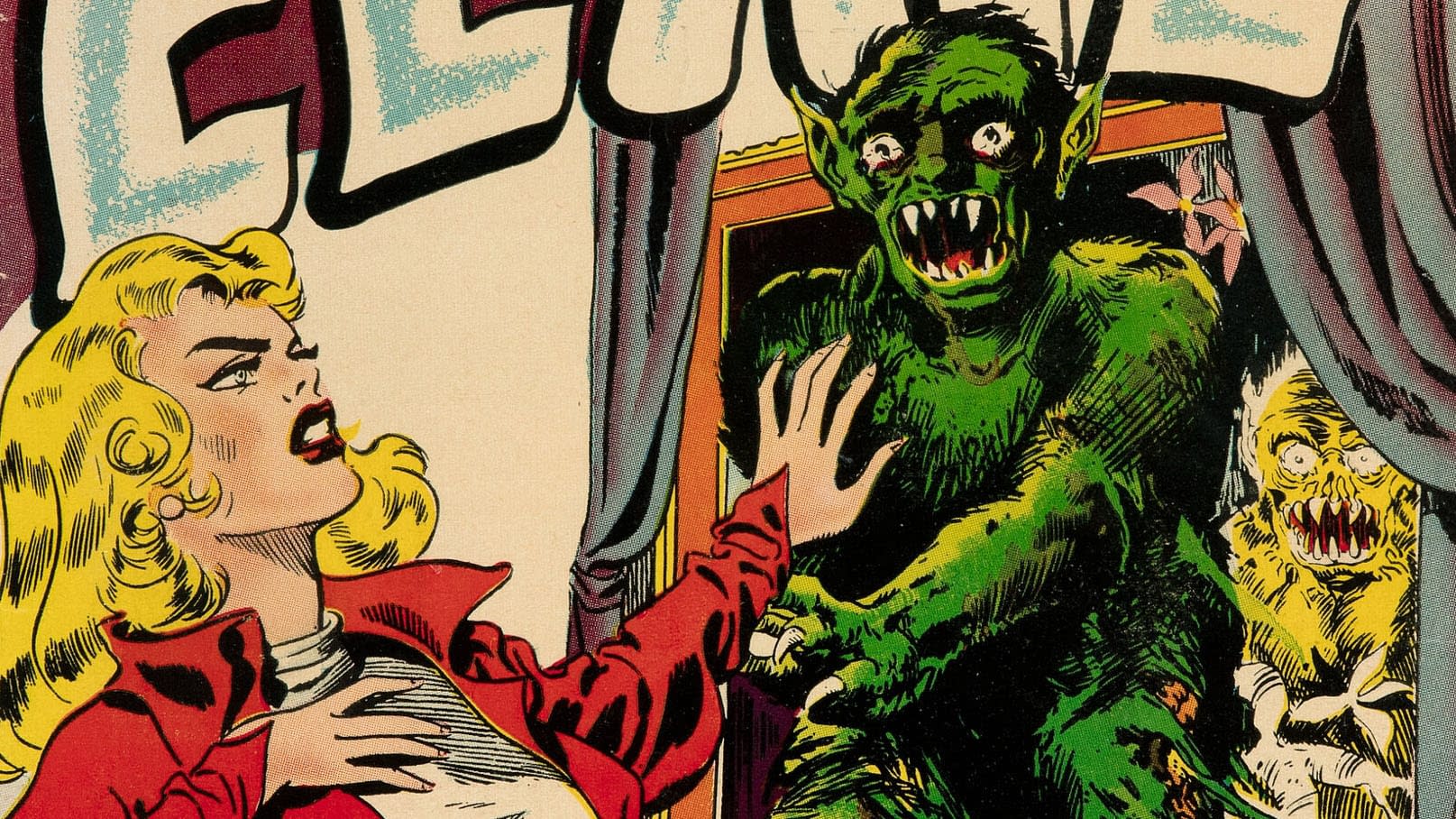
There's a fairly large gap between the Eerie Comics #1 cover-dated January 1947, and the next Pre-Code Horror development, ACG's Adventures into the Unknown #1, Fall 1948, which became the first successful horror comic book series. Like Eerie Comics #1, it contains classic horror mixed with the new, weird wave of Pre-Code Horror. The Pre-Code Horror genre as a thing unto itself begins to truly hit its stride with Amazing Mysteries #32, May 1949, as Marvel enters the horror comic business. Amazing Mysteries #32 is likely much more important than it gets credit for as the start of the boom period of PCH, as Marvel became the driver of the genre with around 389 comic book issues which can be considered PCH, vs EC Comics' PCH output of about 91 comic book issues. EC Comics then snuck into the genre with Crime Patrol #15, Dec/Jan 1949/50. Harvey is another pillar of the PCH era, entering the horror market with Chamber of Chills, Witches Tales, and Black Cat Comics (rebranded as Black Cat Mystery) in 1951, with more to follow.
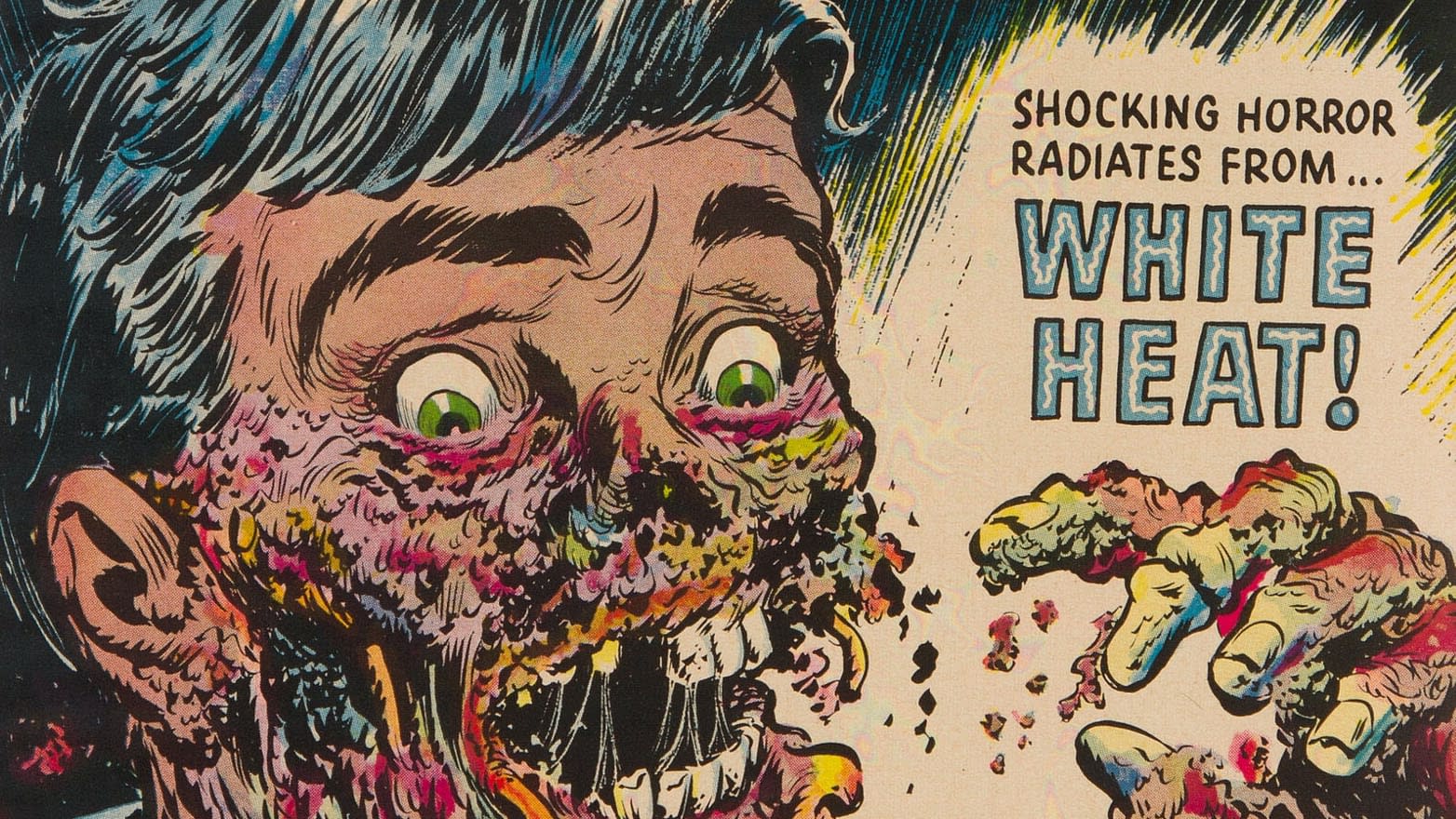
Black Cat Comics #50 is one of the most infamous issues in the Golden Age Good Girl Comic Book Facsimile Collection Kickstarter, and it's also a stellar example of what happened when the seeds planted by Eerie Comics #1 blossomed into the kind of stories and imagery that Pre-Code Horror is known for today. That legendary cover by Lee Elias represents the issue's stand-out story, White Heat, about the consequences of stealing uranium.
This 1954 story is very much the logical consequence of the era that produced Eerie Comics #1. The early 1950s and the atomic age that came along with it created a uranium boom around the world. Not just the explosive kind, but the financial kind as well. This period was akin to the gold rush days of about a century prior to that time in the U.S. as uranium prospecting had gone mainstream. The U.S. Govt was paying out bonuses for uranium site discoveries. You could even get a geiger counter out of the Sears catalog, and learn how to find uranium from any number of mainstream magazines or books from the period.
Naturally, such a boom attracted more than prospectors — it attracted thieves, and rather surprisingly, lots of them. The newspapers of 1949-1954 are full of accounts of uranium theft. In January 1953, for example, Helmuth Goeltzer was arrested for trying to sell a stolen five-pound cube of uranium for $25,000.00. In January 1952, Robert S. Mathews, a former engineer at the Hanford reactor site was arrested by the FBI and charged with stealing a four-pound piece of uranium. That saga commanded headlines around the country for a significant period and is the most likely spark of inspiration for Black Cat Comics #50's White Heat. The 1950 film Radar Secret Service is also about uranium theft. Those are just a few examples out of many incidents that took place during the period that led up to the early months of 1954 when this Black Cat Comics #50 would have been written.
The End of Pre-Code
While the beginnings and endpoints of various vintage comic book eras can often be a matter of debate and differing opinions among collectors, the ending of the Pre-Code era is very simple. By definition, the beginning of the Comics Code Authority marks the end of the Pre-Code era. The Comics Magazine Association of America adopted its Code on October 26, 1954, after public campaigns by Fredric Wertham and others against horror, crime, and risque comic books. This moral panic led to televised hearings during which Wertham and comic book industry figures testified before the U.S. Senate. Complying with the Comics Magazine Association of America Code guidelines became a de facto requirement for distribution to newsdealers in the United States, and comics that received pre-publication approval from Code administrators carried the Comics Code Authority seal on their covers.
Incredibly, that means the Pre-Code era was a surprisingly brief time, coming in at just a little under eight years 1947-1954. Even so, Pre-Code Horror is yet another instance where we could go on for many, many more posts regarding the history of its titles and publishers, and the Golden Age Good Girl Comic Book Facsimile Collection Kickstarter contains gems that also include issues from Startling Terror Tales, Amazing Ghost Stories, Ghost Comics, Dark Mysteries, Manhunt, and many others. But next week, it's time for some romance.

Enjoyed this? Please share on social media!



Stay up-to-date and support the site by following Bleeding Cool on Google News today!