
 About
About 


Scrubs creator Bill Lawrence addresses the revival series' reveal that undercuts the Season 8 finale and how it makes sense in context.
Posted in: Peacock, TV | Tagged: The Copenhagen test
The Copenhagen Test EPs/Showrunners on le Carré Inspiration, Casting
The Copenhagen Test creator Thomas Brandon, co-showrunner Jennifer Yale, and co-EP James Wan discussed Liu, Barrera, themes, and more.
Article Summary
- The Copenhagen Test draws inspiration from John le Carré's spy novels and explores high-tech psychological espionage.
- Creator Thomas Brandon combines classic spy-fi with modern fears about personal data, surveillance, and hacking.
- Simu Liu and Melissa Barrera bring depth to complex roles exploring identity, loyalty, and trust under pressure.
- Showrunners discuss weaving timeless political themes and layered character psychology throughout the narrative.
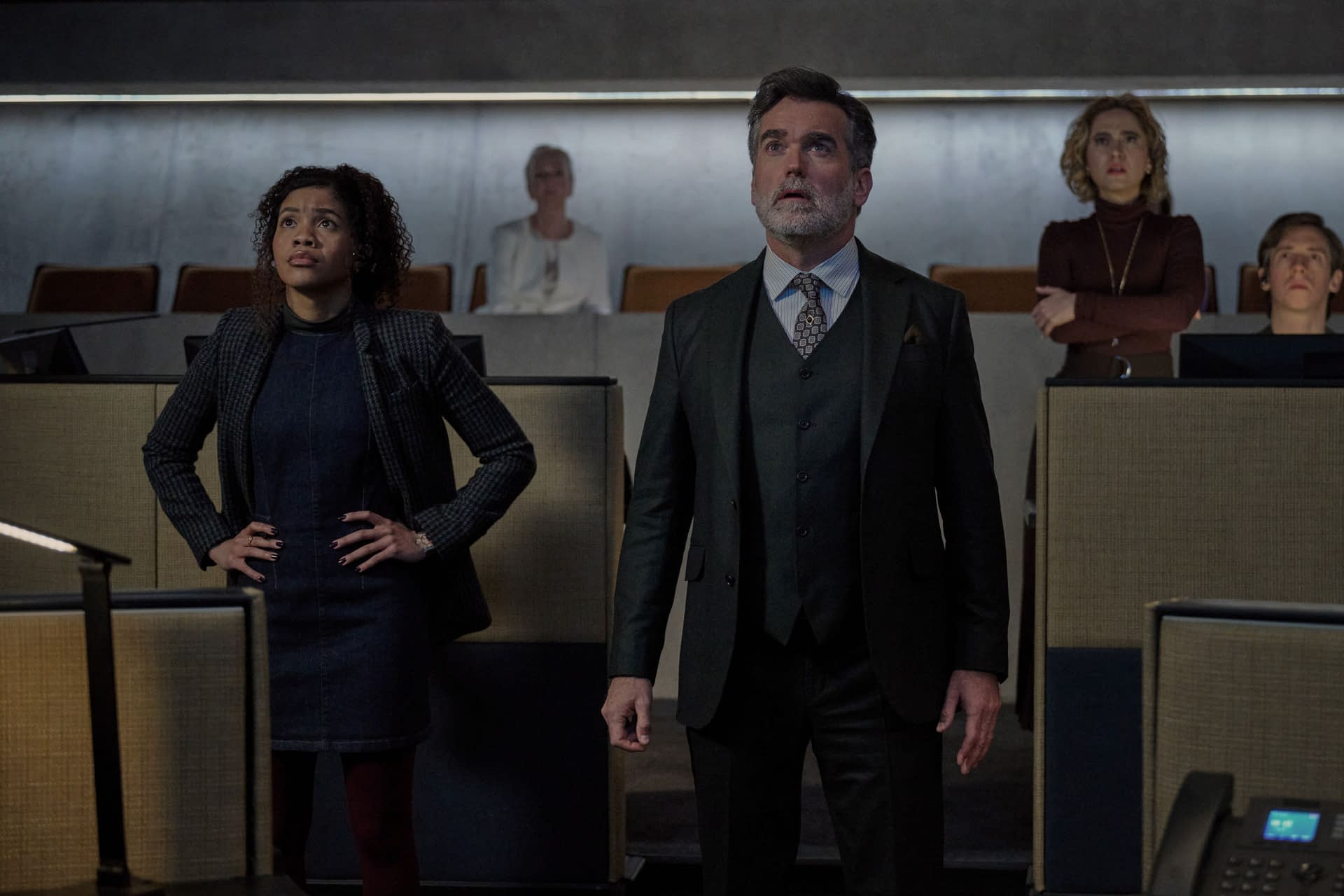
Most times in the world of the spy thriller genres, a compromised individual is often neutralized in service to the greater good with national security, but that's not the case in Peacock's The Copenhagen Test, which follows Alexander Hale (Simu Liu), a first generation Chinese-American intelligence analyst who realizes his brain has been hacked, giving the perpetrators access to everything he sees and hears. Caught between his shadowy agency and the unknown hackers, he must maintain a performance 24/7 to flush out who's responsible and prove where his allegiance lies. The only ally he trusts is Michelle (Melissa Barrera), a bartender, who understands him far more than he realizes. Creator Thomas Brandon (Legacies), co-showrunner/EP Jennifer Yale (See) and EP James Wan (The Conjuring franchise) spoke to Bleeding Cool about how Brandon's love for the spy genre inspired him to create the series, casting Liu (who's also an EP) and Barrera as the leads, deep diving the psychology of Michelle, and the series' political themes.

The Copenhagen Test Creator/EPs on Casting, Psychology, Themes & More
What's the inspiration behind The Copenhagen Test, and how did it come together for Peacock?
Brandon: Yeah, so it started from my love of old school spy novels, like John le Carré's Tinker Tailor Soldier Spy, and then I started thinking, "I just had a laptop that was hacked," and then, I started wondering, "Okay, if I'm worried about my laptop, webcam, and my phone being hacked, what's the next thing? What's five minutes in the future? As a good science fiction writer I realized, "Oh, your eyes and ears being hacked would be the worst thing," and then I started thinking about a low-level analyst in this secretive organization who realizes everything he's looking at is compromising national security, because he is the mole, then paired with the John le Carré's love of spy, I started realizing, "Oh, this is kind of a spy-fi show. We're mixing genres here," and then the last element was just my 1990s love of The Truman Show and the idea of this guy would essentially be living in a fake world. They're building this fake world around him to keep the hat going. He's been assigned a girlfriend, and for him, it's really trying to discover not only what is real or not, but "Who am I? How far will I go? What has been done to me? Is there a way to possibly survive?"
Were Simu and Melissa penciled in from day one as the leads? Was there anyone else you considered?
Wan Simu was definitely one of the very first people we went out to, if not the first one, and we were very grateful that he…I mean, it's a testament to the script, right? He loved the script and the idea of what this world could be. Getting Simu was a big driving force behind "getting the show off the ground," I would say
Yale: We were lucky to have him.

Was Melissa also part of it initially?
Yale: She wasn't part of it initially, but when we cast her, we were fortunate, because she is a tremendous actor, especially for this role specifically. There's a chameleon element to it, and it took us a long time to find the right actor, because it was someone that Thomas has referred to as a Lamborghini.
Brandon: Ferrari.
Yale: I say the wrong one all the time, a Ferrari that can take those tight turns with precision. That was something she came in every day to work and do her scenes with this knowing 10 steps ahead of where she needed to be, and she would bring these ideas that even we hadn't thought of, so it was really a true collaboration with her, and you can see that on the screen. She is tremendous when she must shift from one personality to another.
Wan: To second that, the idea she basically plays it like a nesting doll, right? Like she's one, then you remove it, she's another thing, and a lot of times, she cannot tell which one is the true version of her, and I think that is like the key to the success of her character.
Yale: Yeah, and where she might not know which one is the true character.
Wan: I know it's so interesting you were saying about once like there's a part of me that wants her to be good, and then a lot of times, the next scene happens, and I'm like "Oh, is she not good? Is she okay?" But I want her to be good just because of the great chemistry between her and Simu. They're so great
Yale: You want it to be real.
Wan: Yes. That's right.

As for the way The Copenhagen Test feels, there are prevalent themes of loyalty and trust. I was wondering how much of the current, um, political overtones were woven into the storytelling, or if this is something that's more or less timeless in the narrative?
Yale: We always looked at it as "Politics of all times," and there is a timelessness to it. That's why we used different pieces of history back from World War II, the Cold War, the fall of the Berlin Wall, Tiananmen Square, and being able to show at different points in history, even in other countries. The theme of an individual and their country. And asking, "When are you loyal to your country or loyal to yourself?" Being able to show that in different ways, because then that reflected on our main character, Alexander, and what he was going through.
All eight episodes of The Copenhagen Test, which also stars Sinclair Daniel, Brian d'Arcy James, Mark O'Brien, and Kathleen Chalfant, premiere on December 27th on Peacock.
Enjoyed this? Please share on social media!



Stay up-to-date and support the site by following Bleeding Cool on Google News today!