
 About
About 

"I did corrections on things, insane corrections." Patrick Lamar complains about comic publishers and page rates in court in 1941.
Posted in: Comics, Heritage Sponsored, Vintage Paper | Tagged: golden age, Harvey Comics
Spaceships and Scrap Metal: All-New Comics #4, Up for Auction
All-New Comics #4 (Harvey, 1943) contains a science fiction story "Poison in the Universe" based on real WWII history.
Article Summary
- All-New Comics #4 (Harvey, 1943) features a WWII-inspired sci-fi story reflecting real historical events.
- Poison in the Universe, drawn by Sam Glanzman, sharply critiques pre-war US trade with Japan.
- Includes a Bob Powell story centered on a plot targeting Hitler at Berlin's Sportpalast stadium.
- Rich in wartime themes and notable creator contributions, this issue stands out among Golden Age comics of the era.
The Heritage blurb for Harvey's All-New Comics #4 from 1943 says "WWII/Nazi/bondage cover by Al Avison," but that's understating the case. That cover is more like "space creature Nazis with a human woman captive while an astronaut adventurer comes to the rescue." The vast majority of the time, a weird cover like this would have nothing to do with the interior of the comic book, and you'd chalk it up to just something unusual that was done to try to capture attention on the newsstands, but such is not the case here. It would appear that Al Avison was given an assignment to draw a cover based on the interior story "Poison In the Universe" by an unknown scripter and drawn by Sam Glanzman. That story is seemingly even more surprising than the cover that represents it, but it is also based on some real WWII-era history.
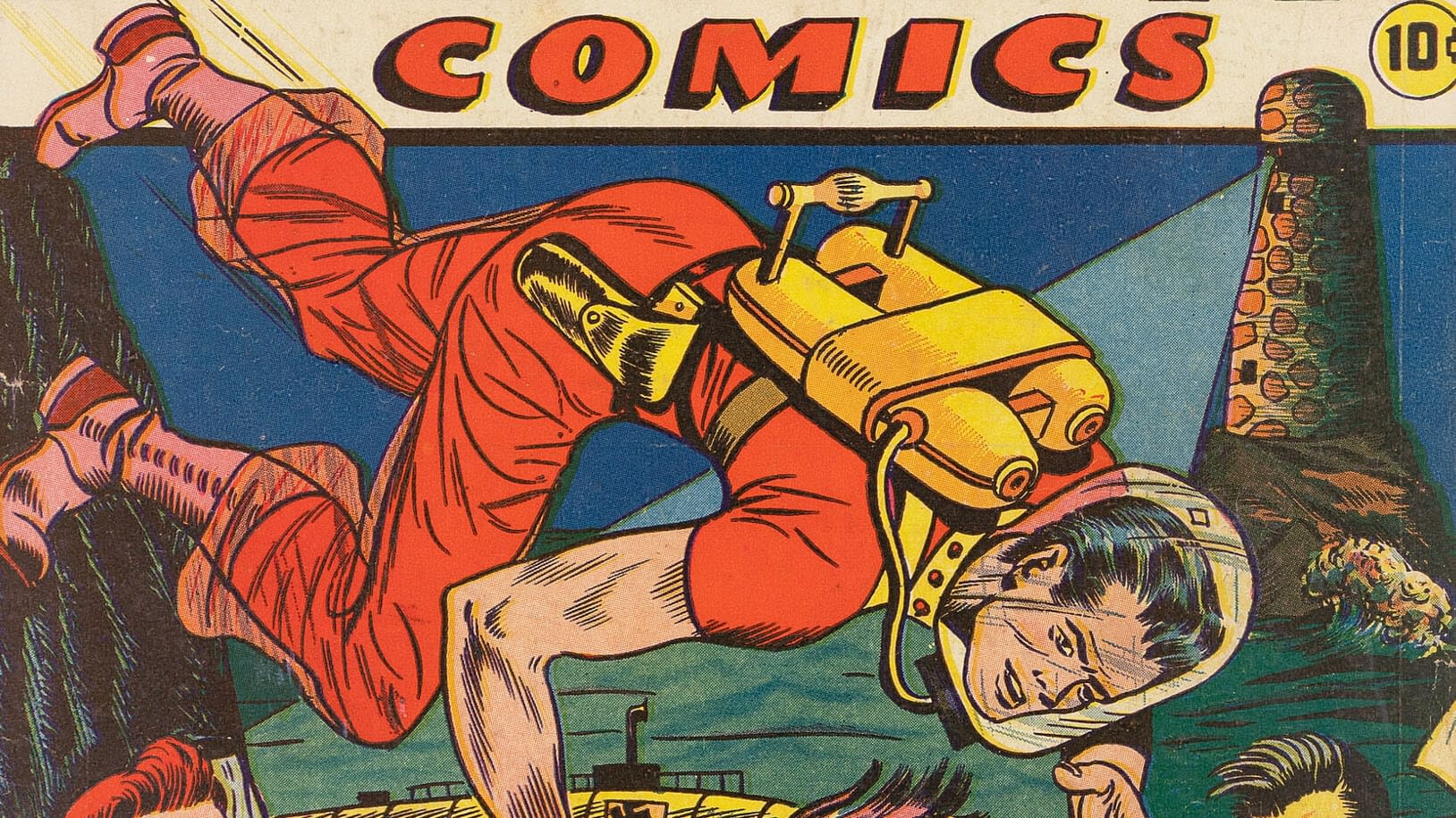
In the story "Poison in the Universe," the United States, Japan, and Earth are represented by separate planets whose names make this obvious. The hero of our story runs a freight ship from the planet Ammer that supplies Iron to the planet Jaan. The Ammer ship captain begins to notice that the leaders of Jaan are using the iron to make weapons of war rather than making things to help the planet's people. The captain warns other men of Ammer about this, but they brush him off and tell him it's probably fine. But soon, the leaders of Jaan see transmissions from Earth which show Hitler making a speech about conquering the entire planet. Seemingly inspired by this, Jaan makes plans to attack Ammer.
This story appears to be inspired by events from the earliest days of World War II and has roots that reach back even further. Following the Japanese invasion of Manchuria and the outbreak of the Second Sino-Japanese War in 1937, the United States remained a primary supplier of strategic materials to Japan. In 1939, Japan relied on the US for approximately 90% of its scrap metal and copper, materials essential for its military expansion. In early 1939, Chinese Americans working at the Port of Portland and the Port of Astoria organized protests against shipping scrap iron and steel to Japan. Despite protests, the situation continued through the next year, as an isolationist Congress was unwilling to disrupt trade relations with Japan at this time. Finally, President Franklin D. Roosevelt was given the authority to control defense-related exports, which he used to halt the export of iron and steel to Japan beginning in October 1940. "Poison in the Universe" characterizes this delay as a near-fatal error. When the Jaan fleet attacks, using ships built from Ammer iron, the story serves as a warning that commerce with dictatorships is dangerous and potentially fatal.
All-New Comics #4 hit newsstands in July 1943, and "Poison in the Universe" may have been artist Sam Glanzman's last completed story before he enlisted in the Navy on April 6, 1943, shortly after he turned 18 years old. Glanzman would serve in the Navy through March 28, 1946, and in later years would be involved in a number of war comics including Our Army at War, Star Spangled War Stories, Weird War Tales, and G.I. Combat at DC Comics, and Attack, Battlefield Action, Fightin' Air Force, Fightin' Marines, Submarine Attack, and U.S. Air Force Comics at Charlton. His autobiographical war stories about his service on the U.S.S. Stevens, beginning in Our Army at War #218, are among his best-remembered works.
The story "Bombs Over Berlin" by Bob Powell is also of particular interest, as it revolves around a suicide mission plan to kill Hitler, Himmler, and Goring with the timely destruction of the Berlin Sportpalast. The site was considered symbolic of Nazi Germany in that era due to a number of speeches given there, including Joseph Goebbels' infamous "Total War" speech on February 18, 1943, which is likely what prompted the creation of this story. Most of the rest of All-New Comics #4 is also very WWII-focused, and overall, the issue is an interesting artifact of its moment in time. There's an All-New Comics #4 (Harvey Publications, 1943) CGC VG- 3.5 Off-white to white pages copy up for auction at the 2025 December 11 Golden Age Comics Century Showcase Auction IV #40315.

Affiliates of Bleeding Cool buy from and/or consign to Heritage Auctions.
Enjoyed this? Please share on social media!



Stay up-to-date and support the site by following Bleeding Cool on Google News today!