
 About
About 
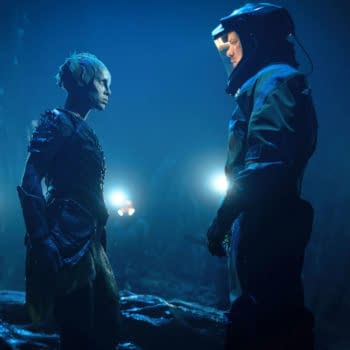
Doctor Who showrunner Russell T Davies still believes in the ending of The War Between the Land and the Sea, but we're still not sold.
Posted in: BBC, Doctor Who, TV | Tagged: doctor who, the war between the land and the sea
Doctor Who: Davies Defends "Land/Sea" Spinoff Finale (Us? Not So Much)
Doctor Who showrunner Russell T Davies still believes in the ending of The War Between the Land and the Sea, but we're still not sold.
Article Summary
- Russell T Davies defends the controversial ending of Doctor Who spinoff The War Between the Land and the Sea
- The finale focused on love between Barclay and Salt as hope, but the romance felt rushed and unearned
- Environmental and thriller aspects were sidelined by inconsistent plotting and underdeveloped character arcs
- Despite script flaws, the series scored strong BBC ratings, proving that there's still an ongoing demand for sci-fi with a message
Showrunner Russell T Davies is very proud of his Doctor Who spinoff, The War Between the Land and the Sea, particularly the ending that some people have looked askance at. The War Between the Land and the Sea didn't have The Doctor in it. Instead, it followed Russell Tovey's everyman hero Barclay, and Gugu Mbatha-Raw's Salt, unlikely ambassadors for two different species who get thrown together when the world faces up to a conflict between the land and the oceans. What was pitched to us as an intense environmental Science Fiction thriller ended up as Davies's fanfic gender-flipped remake of Guillermo del Toro's The Shape of Water.
Your Doctor Who Spoiler Warning Ahead: "All You Need is Love!"
At the end of The War Between the Land and the Sea, corrupt political and business forces drive the aquakind to near-extinction before they can wipe out the human race, effectively ending the war. Barclay and Salt run away to the oceans to be together, with Barclay growing gills to become a fish man.
In the documentary about the making of the spinoff on the Doctor Who YouTube channel, Davies explained: "In the end, what we have is love. Actually, it's very much, as I've explained before, where the show comes from – who we love, what we love, and how we should express that love and show it.
"The stage directions for that final scene say – and there was no way of voicing this on camera – but the stage directions say, that's the point, if there's hope for anyone, it's in those two.
"It's the way they become each other. It's like there is no land, there is no sea. They're both the same. And they physically become the same, and they're recognising the same. There's hope for any of us in any situation. It's always that. It's a hard-won ending, and I think it's beautiful and I'm very glad we did it."
"One of the most boring things you can ever say to a writer is, 'Don't be preachy,' said Davies. "Quite a few religions have been based for thousands of years upon preaching. It's not bad as a system; it works. The truth is, I don't have to get on a high horse at all. If I'm writing about the oceans in 2025, then they really are filthy and stinking and half-destroyed. I would be lying if I didn't mention these things. It's only politically engaged because it has no choice."
Just One Problem: The Love Story Didn't Feel Authentic
I'm not the first or only one who's said this, but the big flaw of that ending is that it felt forced, rushed, inauthentic, and unearned. The love story between Barclay and Fish felt shoehorned in, and virtually all the environmental thriller parts of the story were shunted aside. There was no real feeling that Barclay and Fish developed a bond that drew them together. It was all in a "because we say so" script, just to have him decide in the end to abandon his teenage daughter to run off with his fish girlfriend. This didn't feel like a love story, more like a midlife crisis. To be fair, who in their right mind wants to be stuck raising a teenager with a judgmental ex-wife looming over their shoulder?
The real problem is in the script. After a very promising pilot episode and set-up, the other four episodes proceeded to go off the rails. The heroes – Barclay, Kate Lethbridge-Stewart, and the rest of UNIT – were reduced to idiots waiting for the baddies to pull off their awful thing and stand around helplessly while the bad guys committed genocide. Then the rest of the plot was about Barclay mooning over Salt, who gets to run away with her at the end. That's terrible plotting. It should have married Barclay and Salt's love story with the environmental peril, but the two elements felt separate, like the scripts needed three more drafts to become thematically and dramatically coherent. Yet that didn't stop the series from getting perfectly decent ratings in the UK on BBC One and streaming on iPlayer, which just goes to show that there is an audience hungry for Science Fiction thrillers with a message.
As for love? Well, love sometimes conquers all in Doctor Who, but only because the writers say so.
Enjoyed this? Please share on social media!



Stay up-to-date and support the site by following Bleeding Cool on Google News today!