
 About
About 


Image Comics August 2026 solicits launch Hammerfist, The Last Driver, Unfinished Tales, Bug Wars, Chachu, Death Vigil, Regicide & Yumi: 00EX
Posted in: Comics, DC Comics | Tagged: absolute, Absolute Wonder Woman, Absolute Zatanna, Hayden Sherman, kelly thompson, wonder woman, zatanna
Kelly Thompson Writes Absolute Wonder Woman As Queer, Whatever DC Says
Kelly Thompson on writing Absolute Wonder Woman as queer, no matter what DC Comics may say...
Article Summary
- Kelly Thompson discusses writing Absolute Wonder Woman as queer, regardless of DC's official stance
- Diana's unique, hellish origin redefines her identity and opens the door to broader LGBTQ+ storytelling
- Long-term story plans mapped out with artist Hayden Sherman, featuring dynamic visual storytelling
- Themes of transformative love, identity, and queerness are central to Absolute Wonder Woman's narrative
Friends-of-Bleeding Cool Omar and Melanie of the Near Mint Condition YouTube channel interviewed Kelly Thompson this week, including a discussion about her approach to the character's sexuality, while also diving deep into the radical, hellish reimagining of Diana and her long-term plans for the series.
Kelly Thompson was unequivocal about her intent for the character in the Absolute Wonder Woman line as Melanie asked her directly about the character's sexuality. "I am writing her as a queer character, that's not the same as saying DC will definitely allow her to be canon queer on the page," she explained. "I don't have an answer for that. Traditionally, in alternate universes, Diana has been allowed that flexibility that I personally believe she should always have. But I think it's a little bit like we're being foisted by our own success… we made her so popular, it all became such a phenomenon that then… I don't know. I guess it becomes a different question for them. I can't honestly answer that question. I don't know that anyone at DC can. We're taking it on an 'as-it-goes' basis. There has been some frustration for me on this point. I hope I'm not going to get in trouble for what I'm saying right now. I think it's obvious when you're reading the book."
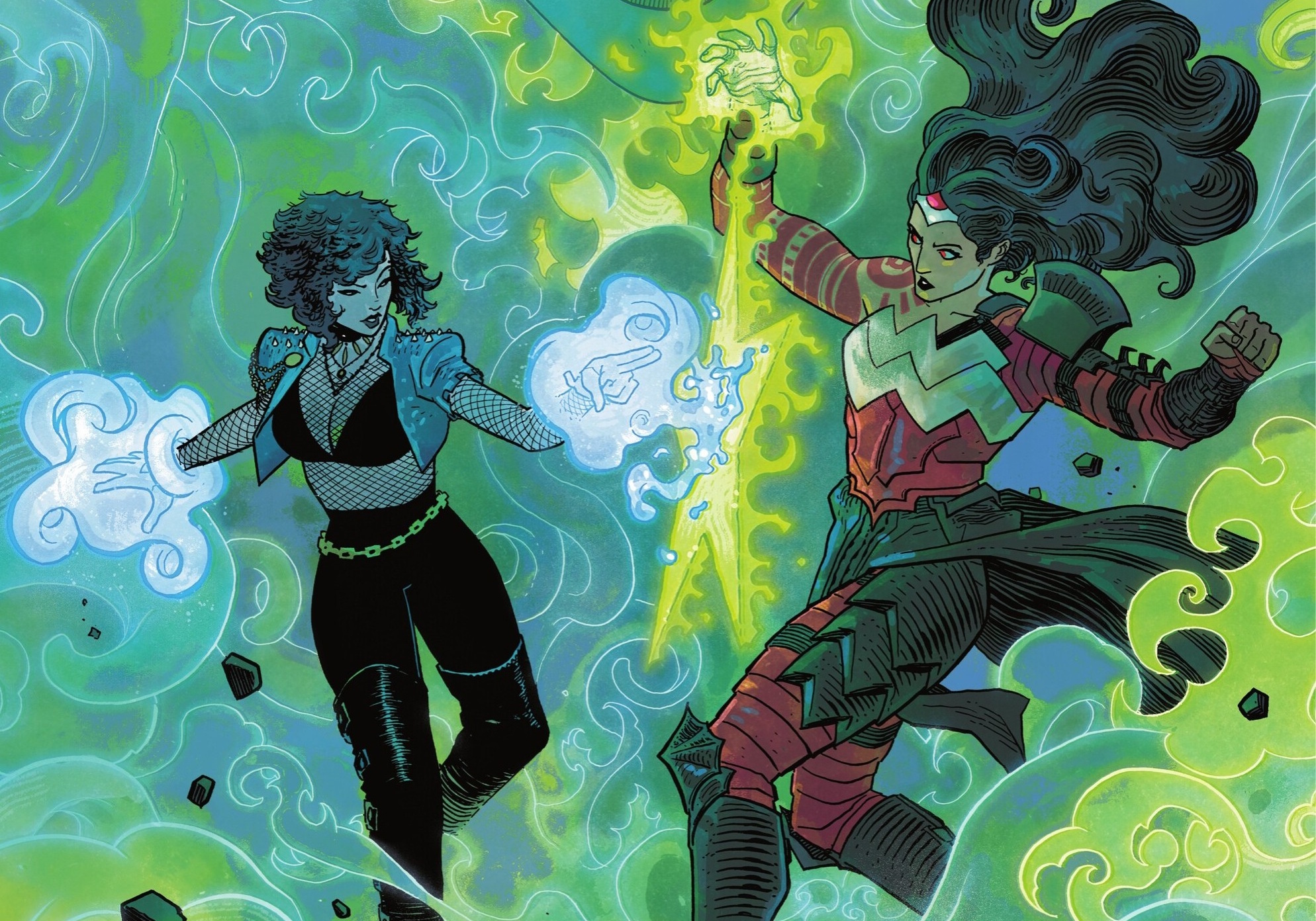
Kelly Thompson tied Diana's queerness directly to the character's unique upbringing and philosophy in this version. "Diana is beyond thinking about people's gender as a construct," Thompson continued. "She grew up in hell with demon pets… She is not going to think, 'Oh, I really love this person. It's too bad they don't have the right equipment.' Like she's just not built that way. She's a unique person in the world, in the universe. And it seems truly laughable to me to be like, "Oh, no, she's straight, or she's a lesbian. She is only into this one thing." It's the antithesis of what I think of as Diana. So it's impossible for me not to write her queer. I think she's everything. That's about as much as I can say."
But she did say more. "I worry that I've put this question too forward in Diana's story… I get excited about all the stuff that's happening with her too. And it's a feedback loop, when the fans get excited, I feel that excitement, and I get excited too. like we all do, the whole team… I'm sure DC feel it too. So you want to lean into what everyone's enjoying and what's happening, but if I'm totally honest, I don't think Diana really has room for love in her life, in a romantic love kind of way. That would be a whole new journey for her. Like a chapter she hasn't even unlocked. And like she's got just bigger fish to fry… she has incredibly important do-or-die things on her plate. I'm not saying that doesn't mean she can't fall in love as she's going through it. I think that's why we sort of lean into the Zatanna stuff because it was just what was happening on the page. It was what was organically happening from smashing those characters together. And it was really fun and I don't want to run away from it. At the same time, it doesn't really feel right to me that Diana would sort of selfishly pursue a relationship at this point in her nascent…. she's only been on Earth… top side for six months in the actual history. So, it's tricky.. let's try to just tell the best story we can. And so I think that's where we end up and I hope that's happening but I don't know."
Omar also brought up Chris Claremont's experience writing X-Men, where it was suggested but definitely forbidden. Kelly Thompson mentioned Peter David and Joe Quesada's X-Factor #87 psychiatrist issue as her own secret origin in writing comics, looking at how characters tick, and added, "I'll be honest, I write most of my characters as queer. I gotta be honest. And it's not because I have some agenda. It's not because I think everyone should be gay. It's because I think in the fictional worlds that we've built and that these people live in, like once you've hung out and fought battles with a talking raccoon, I'm not saying you want to sleep with the raccoon. I'm just saying the universe is so vast. It's not like for you and me and Melanie where we're walking around the street and there's just human beings walking around and those are the only people that are an option for you, this is a world where aliens and people from other planets, it's just a crazy universe. It seems bizarre to me that people who've had the experiences that superheroes have had, going to other planets and stuff, would still be so locked down to binary gender rules."
The past, and future, of Absolute Wonder Woman
Thompson shared that she has been mapping out Absolute Wonder Woman with significant lead time and a lean creative team, giving her the runway to think long-term. Talks with DC began in the autumn of 2023, which was exactly the time Bleeding Cool was first reporting its existence. There are some other aspects about the initial plans for Absolute Wonder Woman that I need to dig into, but that's another article. Kelly Thompson's active work began starting in early 2024. She has already plotted the book well into the future, specifically mentioning plans through at least issue 34, with no planned endpoint as long as the Absolute Universe continues. Thompson pushed back against any criticism that the stakes feel too "normal," arguing that the personal and emotional scale of Diana's journey carries its own dramatic weight.
Thompson revealed that the demonic reimagining of Wonder Woman, raised in the underworld by Circe rather than on Themyscira, came from a moment of creative frustration during early development. She had been struggling to crack the character for the Absolute line, feeling that many initial ideas stripped away too much of what makes Diana recognisable. The breakthrough came when she flipped the script entirely. "The idea that called to me like a shining beacon on a hill was something like, 'Witch Diana, raised in hell, but in love, by her enemy.' And then I think it said 'Circe????' and I just… I knew I could write the hell out of that."
This setup allowed Thompson to explore themes of transformative love in the harshest environment imaginable, in stark contrast to the utopian Amazonian heritage of classic Wonder Woman. "Realising that Diana's love is a transformative thing and that once it transformed Circe, Circe would begin feeding it back to Diana, and even though they were in hell, it would be home for them. It would still be love and kindness and finding a better way. And in fact, it would shine all the more brightly as it was contrasted against their surroundings." The hellish origin also opened the door to heavier magic elements, wilder fight choreography, and a clear differentiation from Superman's sci-fi roots. Thompson has drawn inspiration from creators like Greg Rucka, Gail Simone, and George Pérez, as well as Kingdom Come, while using Daniel Warren Johnson's Wonder Woman: Dead Earth as a boundary-setter for what the Absolute line could do. She emphasised that the series remains deeply accessible, with a strong appeal to younger readers discovering Greek mythology through the book, including teens reportedly reading it in class. I wonder which will be the first to ban it? The full Kelly Thompson interview video can be watched above, or linked here from the Near Mint Condition YouTube channel.
Enjoyed this? Please share on social media!



Stay up-to-date and support the site by following Bleeding Cool on Google News today!