
 About
About 


Jay Mewes is expanding his talents to the new YouTube series 5 Things, featuring guests Melissa Benoist, Patrick J Adams, Logic, and more.
Posted in: Documentary, Movies, Star Trek, TV | Tagged: star trek
Star Trek VFX Specialist on Embracing Versatility Behind the Scenes
VFX specialist Doug Drexler (Trek Star) spoke with us about his upcoming documentary celebrating his career as a Star Trek pioneer.
Article Summary
- Doug Drexler shares insights on his versatile Star Trek career, spanning makeup, VFX, and art departments.
- From cult horror beginnings to Star Trek legend, Drexler discusses following his creative dreams in Hollywood.
- He reflects on working closely with Star Trek icons and the unique challenges of diverse behind-the-scenes roles.
- Drexler's upcoming documentary highlights his journey and invites fans to support via Kickstarter and YouTube.
To call Doug Drexler royalty in the creative world of Star Trek would be an understatement, from growing up living, breathing, and embracing the franchise in his youth to finding as many roles behind and in front of the camera to contribute however he can. While he had his start in makeup, he leveraged his experience in the Gene Roddenberry franchise into an educational opportunity, casting a wide net of skill sets across various franchise projects in film and TV, including The Next Generation. While promoting his documentary Trek Star: The Doug Drexler Documentary, he's working with Jason E. Smith on Kickstarter. Drexler spoke with Bleeding Cool about his start in Hollywood, his preference for working in TV, achieving his dreams early in life, and gaining the invaluable experience of spreading himself out on the Star Trek set.
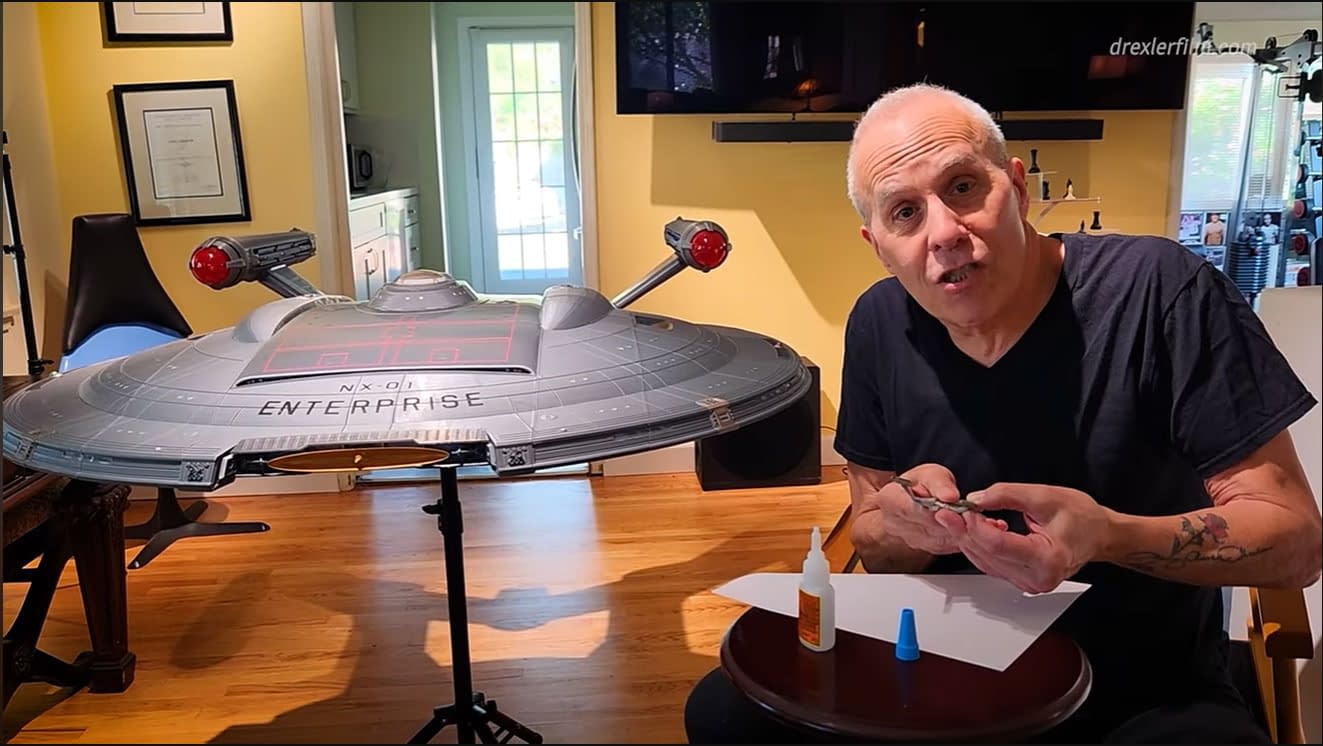
Star Trek Icon Doug Drexler on Getting His Start in Horror, Taking in His Dream Job, and Embracing as Many Creative Departments as Possible
When you got your start in that cult classic, The Hunger (1983), did you ever imagine that your career would go the way it has?
Well, I mean…I didn't think there was ever a chance of working on Star Trek. They were doing movies (at the time). When I was working with Dick [Smith] on The Hunger, The Wrath of Khan (1982) came out at that time, and so I knew there was a possibility now that I was in the business, but I never thought there'd be another television series, which is what I'd rather work on rather than a movie.
Adding that, what do you feel is the secret to your longevity?
The secrets of my longevity?
In your career, yes.
Not taking anything too seriously [laughs]. That's my advice to everybody: "Don't take it so seriously."
Behind the scenes, you wore so many hats in Star Trek, and joined the franchise in the middle of Next Gen's run here. What were your first impressions stepping onto the set there, knowing what galaxies and possibilities lay before you?
I worked on doing features at Star Trek for like 10 years, so I was used to being with a crew, but this was Star Trek. Gene Roddenberry was still alive, and so was Robert H. Justman. To me, those guys are heroes of mine, and other people were on Next Generation from The Original Series. That group meant so much to me, so it was extra special to go on stage. When you go onstage, they keep it so cold, and when you go in from the hot California sun to a stage, you have the sun baking you. Then you go in, and there is this vault door that slams behind you, and it's dark and it's like the Arctic in there, and it's like passing through a membrane into another existence. The first time I went on stage, it wasn't a big, impressive set, but oh my God! I mean, there was Jonathan Franks as Riker and in a scene with Patrick Stewart. I was already a huge fan of the show before I got there, and now, I'm actually on stage, and nobody gets closer to the actors than the makeup artists.
As far as the creative process goes, since you were part of that makeup process with constructing the look of the aliens, and at the other end of the spectrum, you were also designing starships. How do you break down the process with your teams, and is one easier than the other? Was there an ebb and flow?
Yeah, that was an ebb and flow, because it didn't always go right [laughs], and not going right is an exciting part of doing it. If you work in a business, you get used to taking the catastrophes and making them intrinsic to the success. As far as which (was more difficult?) there were visual effects, art department, and makeup. Makeup is difficult work. You are there hours before anyone else, and you leave hours after everyone else. You could come in at 2 a.m., and you might not leave until 1 a.m., not kidding. It's physically demanding on you, especially if a makeup artist is like performance art, almost like an athletic event. There's a physical aspect to it that you're creating, and it's going to walk out there on set. It better be ready!
The last thing you want is Patrick Stewart to be late getting to the wardrobe, and so, he's late getting to the set. They're going to look at that and say, "Well, where did it go wrong?" and put it in a report that it was makeup. That's the last thing I want to do, but art department can be tough. Visual effects are a lot like makeup. You could be sleeping on the floor, doing visual effects. That's hard work too.
The art department is difficult, but it's more civilized. You're not working on an actor; they're not waiting for you on stage. They will be waiting for you on stage in about a week once you get the project, but I prefer makeup to everything, even though I've had such great success on all the others. Makeup was the only thing that I did that touched on everything in some aspect, whether it was visual effects or any aspect of it that the art department had some connection to some input too, and I loved that. You never knew what it was going to be.
With makeup, it's starting to get the same after a while. Although most makeup artists, friends of mine, stay makeup artists for 40 years, they don't do other stuff, but I just couldn't. Picture that you're on Star Trek, and there are these other departments you've read about for years since you were a little kid. Don't you want to get into the visual effects department? Yeah, let me in! Honestly, if I had more time, wardrobe would probably be great. I'd love to get into a wardrobe and design costumes. When you're on a show like that, you love the whole (part and) you're dedicated to it. Then you have these other departments, and they already know you from the art department. Gary Hutzel has known me for years in the art department. If I say, "Hey, Gary, is there any way I could slide sideways into…" or he'd pursue me/ It was just a smorgasbord of Star Trek, all different departments. I could not stay in one place.
For more information on Drexler, you can visit the Kickstarter page for the documentary, which includes details on how to contribute, with less than a week remaining to meet the goals. You can also check out the documentary's YouTube page for videos chronicling his journey.
Enjoyed this? Please share on social media!



Stay up-to-date and support the site by following Bleeding Cool on Google News today!